Technical SEO Services: What Does an SEO Agency Actually Do?
Discover what technical SEO services include, what an SEO agency actually does, and how technical SEO can improve crawling, indexing, performance, and search visibility.
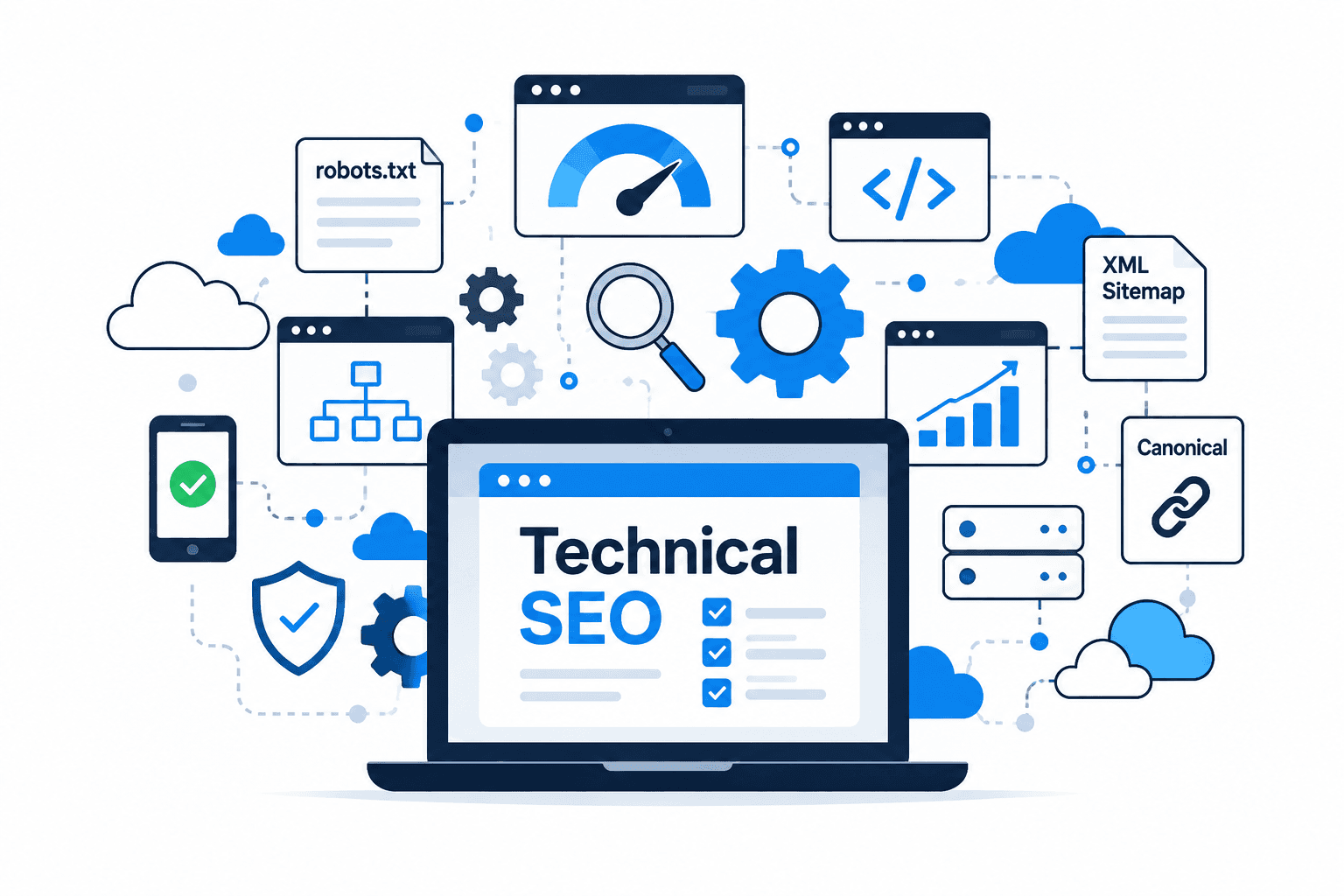
Technical SEO Services: What Does an SEO Agency Actually Do?
Technical SEO services focus on the technical foundation that helps search engines crawl, understand, index, and evaluate a website.
A professional technical SEO agency does more than run an automated audit and send a list of errors. The real work involves identifying technical problems, understanding how those problems affect organic search performance, prioritizing the highest-impact fixes, and helping businesses implement a stronger search-ready website.
For businesses competing in Google Search and increasingly AI-powered search experiences, technical SEO provides the foundation for everything else.
What Are Technical SEO Services?
Technical SEO services are professional optimization services focused on the technical elements of a website that can affect crawling, indexing, search visibility, performance, and user experience.
Depending on the website, technical SEO may include:
- Technical SEO audits
- Website crawling and indexation analysis
- Robots.txt optimization
- XML sitemap optimization
- Canonical URL management
- Redirect and status-code analysis
- Duplicate-content and URL issues
- Internal linking and site architecture
- Core Web Vitals optimization
- Mobile usability
- JavaScript SEO
- Structured data
- HTTPS and security checks
- International SEO implementation
- Website migrations
- Technical monitoring
If you want to see what professional implementation can include, explore our Technical SEO Services.
score = (business_value * ranking_gap) / implementation_effortWhat Does a Technical SEO Agency Actually Do?
A technical SEO agency typically works through several stages rather than treating SEO as a one-time checklist.
1. Audit the Website
The first step is understanding how the website currently performs from a technical SEO perspective.
An agency may analyze:
- Crawlability
- Indexability
- HTTP status codes
- Redirects
- Canonicalization
- XML sitemaps
- Robots.txt
- Internal links
- Page speed
- Core Web Vitals
- Structured data
- Mobile experience
- JavaScript rendering
- Duplicate URLs
- Thin or problematic pages
The purpose of an audit is not simply to find as many issues as possible.
The goal is to identify the problems that matter most to organic search performance.
For a deeper checklist, see our Technical SEO Audit Checklist.
2. Analyze Crawling and Indexing
Search engines need to be able to discover and process the pages that matter.
Technical SEO services often examine whether important pages can be crawled and indexed correctly.
Common problems include:
- Important pages blocked by robots.txt
- Accidental
noindexdirectives - Incorrect canonical tags
- Broken internal links
- Orphan pages
- Poor XML sitemap configuration
- Redirect chains
- Soft 404 pages
- Duplicate URLs
Google's Crawling and Indexing documentation explains how Google discovers and processes website content.
A page that cannot be crawled or indexed cannot generate organic traffic regardless of how good its content may be.
3. Improve Website Architecture
A technically healthy website should also have a logical structure.
Technical SEO specialists may review:
- URL structure
- Navigation
- Category and service hierarchies
- Internal linking
- Breadcrumbs
- Important-page depth
- Content relationships
- Duplicate URL pathways
Strong architecture helps search engines discover important pages and understand how different parts of a website relate to each other.
It can also make it easier for users to move from informational content to commercial pages.
For a broader view of organic search strategy, see our SEO Services.
4. Fix Technical Errors
After the audit and analysis, technical SEO work moves into implementation.
Depending on the website, this may involve fixing:
- Broken pages
- Redirect errors
- Canonical issues
- Indexation problems
- Sitemap problems
- Robots.txt issues
- Duplicate URLs
- Internal linking problems
- Incorrect HTTP status codes
- Rendering problems
- Structured-data errors
The important distinction is that professional technical SEO is not simply about producing a report.
The value comes from turning the findings into practical improvements.
5. Improve Core Web Vitals and Website Performance
Website performance is another important part of modern technical SEO.
Technical SEO services may investigate metrics such as:
- Largest Contentful Paint (LCP)
- Interaction to Next Paint (INP)
- Cumulative Layout Shift (CLS)
According to web.dev's Core Web Vitals guidance, these metrics focus on loading performance, interactivity, and visual stability.
Performance optimization can involve reducing unnecessary JavaScript, improving image delivery, optimizing fonts, reducing render-blocking resources, improving caching, and addressing slow server responses.
Not every performance problem requires the same solution.
A good technical SEO process identifies the underlying cause before recommending a fix.
For a more detailed explanation, read our Core Web Vitals 2026 guide.
6. Implement Structured Data
Structured data helps provide search engines with machine-readable information about supported entities and content types.
Depending on the website, an agency may review or implement appropriate structured data for things such as:
- Organizations
- Local businesses
- Products
- Articles
- Breadcrumbs
- Events
- Services
Structured data should accurately represent the visible and supported content on the page.
It should not be treated as a shortcut for rankings.
Google provides detailed guidance in its Structured Data documentation.
7. Review JavaScript SEO
Modern websites often depend heavily on JavaScript.
That can create additional technical SEO considerations.
An agency may investigate whether important content, links, metadata, or other signals are accessible when search engines process the page.
This becomes particularly important for JavaScript-heavy applications, dynamic websites, and modern web frameworks.
Google's Crawling and Indexing documentation also covers how JavaScript and rendering relate to search engine processing.
8. Monitor Technical SEO After the Fixes
Technical SEO should not necessarily end after the initial audit.
Websites change constantly.
New pages are published, developers deploy updates, plugins change functionality, URLs are redirected, templates are redesigned, and migrations happen.
Ongoing technical SEO monitoring can help identify new problems before they become larger issues.
For websites with frequent technical changes, ongoing monitoring can be particularly valuable.
What Is Included in a Technical SEO Service?
A technical SEO service can vary significantly between agencies.
A professional engagement may include several of the following:
| Technical SEO Area | Typical Work |
|---|---|
| Technical Audit | Crawl and technical issue analysis |
| Crawlability | Robots.txt, links, crawl paths |
| Indexation | Noindex, canonicals, sitemap analysis |
| Site Architecture | URL hierarchy and internal linking |
| Performance | Core Web Vitals and speed optimization |
| Structured Data | Schema implementation and validation |
| JavaScript SEO | Rendering and content accessibility |
| Redirects | Redirect chains, loops, and incorrect redirects |
| Status Codes | 4xx, 5xx, soft 404 and other response issues |
| Mobile SEO | Mobile usability and responsive issues |
| Migrations | URL mapping, redirects, indexation checks |
| Monitoring | Ongoing technical issue detection |
The right scope depends on the website rather than a fixed checklist.
For businesses looking for hands-on implementation, RankForge Technical SEO Services provide technical analysis, indexation diagnostics, Core Web Vitals guidance, structured data validation, rendering review, and internal-link architecture recommendations.
Technical SEO Audit vs. Technical SEO Services
These terms are related but they are not the same thing.
A technical SEO audit is primarily an assessment.
It identifies problems, opportunities, and priorities.
Technical SEO services can go further by including:
- Technical analysis
- Prioritization
- Recommendations
- Implementation support
- Testing
- Monitoring
- Ongoing optimization
For example, an audit may discover that hundreds of URLs have incorrect canonical tags.
A technical SEO service would not stop at reporting the problem. The next step would be determining why the issue exists, correcting the implementation, validating the changes, and monitoring the website afterward.
If you want to understand the difference in more detail, read Technical SEO Audit vs. SEO Audit: What's the Difference?.
Why Do Businesses Need Technical SEO?
A website can have excellent content and strong backlinks but still experience technical problems that limit organic search performance.
Technical SEO helps create a stronger foundation for:
- Search engine crawling
- Indexation
- Site discovery
- Website performance
- Internal link flow
- Search visibility
- User experience
Technical SEO is especially important when a website has thousands of pages, a complicated architecture, frequent development changes, or a history of migrations and technical changes.
For smaller websites, the required work may be much more focused.
The objective is not to make a website technically complicated.
The objective is to make it technically sound.
When Should You Hire a Technical SEO Agency?
Businesses may benefit from professional technical SEO support when:
Your website has lost organic traffic
A technical investigation can help determine whether crawling, indexing, migration, performance, or other technical changes are contributing to the decline.
Google is not indexing important pages
If valuable pages are not appearing in Google's index, technical analysis can help identify potential causes.
You can also review Google Search Console Crawl Stats and technical SEO problems to understand how crawl activity can reveal technical issues.
You are launching a new website
Technical SEO can be incorporated into the website architecture before launch rather than fixing avoidable problems afterward.
You are migrating your website
Website migrations can introduce broken URLs, lost redirects, canonical problems, indexation issues, and other technical risks.
Google's site migration documentation provides guidance on protecting URLs, redirects, sitemaps, and indexation during site moves.
Your website is slow
Technical SEO and performance analysis can identify opportunities to improve loading and interaction performance.
Your website has become difficult to manage
Large websites can accumulate duplicate URLs, inconsistent templates, orphan pages, redirect problems, and other technical issues over time.
You are investing heavily in content
Publishing more content does not automatically create more organic visibility.
Technical SEO helps make sure search engines can efficiently discover and process the content that matters.
How Much Do Technical SEO Services Cost?
Technical SEO pricing varies depending on the website and scope of work.
Factors that can affect cost include:
- Website size
- Number of URLs
- Website platform
- Technical complexity
- International targeting
- JavaScript usage
- Existing technical problems
- Migration requirements
- Implementation needs
- Ongoing monitoring requirements
A small business website may need a focused technical SEO project, while a large ecommerce or enterprise website may require significantly more analysis and ongoing technical support.
For this reason, professional agencies often evaluate the website before recommending a specific scope and price.
How to Choose a Technical SEO Agency
When comparing technical SEO agencies, look beyond promises about rankings.
A strong technical SEO partner should be able to explain:
- What will be audited
- How issues will be prioritized
- Which problems affect your business
- What implementation support is included
- How fixes will be validated
- How progress will be measured
- What happens after the initial audit
Be cautious of agencies that present hundreds of automated warnings without explaining their actual SEO or business impact.
Technical SEO is not about fixing every warning.
It is about fixing the right problems.
Technical SEO for Modern Search
Technical SEO is also becoming more important as search evolves beyond traditional blue-link results.
Businesses increasingly need to consider visibility across:
- Traditional Google Search
- AI Overviews
- Google AI Mode
- Answer engines
- Other AI-powered discovery experiences
The fundamentals still matter.
Search systems need accessible, understandable, well-structured information.
Technical SEO therefore remains a foundation for broader search visibility, even as the way people discover information changes.
Final Takeaway
Technical SEO services are about building and maintaining the technical foundation that allows a website to be effectively crawled, understood, indexed, and experienced.
A professional technical SEO agency should do more than identify errors.
It should determine which issues matter, prioritize them, help implement the right fixes, validate the results, and continue monitoring the website as it changes.
For businesses serious about organic growth, technical SEO is not simply a checklist.
It is part of the infrastructure behind sustainable search visibility.
If you want to identify the technical issues affecting your website, a technical SEO audit is a practical place to start.
Frequently Asked Questions
What are technical SEO services?
Technical SEO services focus on improving the technical elements of a website that affect crawling, indexing, performance, site architecture, and search visibility.
What does a technical SEO agency do?
A technical SEO agency audits websites, identifies and prioritizes technical problems, recommends or implements fixes, validates changes, and may provide ongoing technical monitoring.
How much do technical SEO services cost?
Technical SEO pricing depends on factors such as website size, platform, technical complexity, number of URLs, and whether implementation or ongoing monitoring is required.
Is a technical SEO audit the same as technical SEO services?
No. An audit primarily identifies problems and opportunities, while technical SEO services can include implementation, testing, optimization, and ongoing monitoring.
When should a business hire a technical SEO agency?
Businesses may benefit from technical SEO support when experiencing indexing problems, organic traffic declines, slow performance, website migrations, complex technical issues, or rapid website growth.
Does technical SEO still matter for AI search?
Yes. Technical SEO remains important because search systems need to access, process, and understand website content. Technical SEO provides a foundation for broader visibility across modern search experiences.
Ready to Improve Your Website's Technical SEO?
Whether you're struggling with crawl errors, indexation issues, slow Core Web Vitals, structured data problems, or AI Search readiness, RankForge can help.
Our Technical SEO services can help with:
- Complete crawl analysis
- Indexation review
- Core Web Vitals optimization
- Structured data validation
- Internal linking recommendations
- Website architecture review
- AI Search Optimization
- Prioritized implementation roadmap
Ready to turn this into a roadmap?
RankForge can audit your site, prioritize the best opportunities, and build the growth system behind them.
Request free audit