Technical SEO Audit Checklist for Higher Rankings
Use this technical SEO audit checklist to fix crawlability, indexing, Core Web Vitals, schema, and AI search issues that limit rankings.
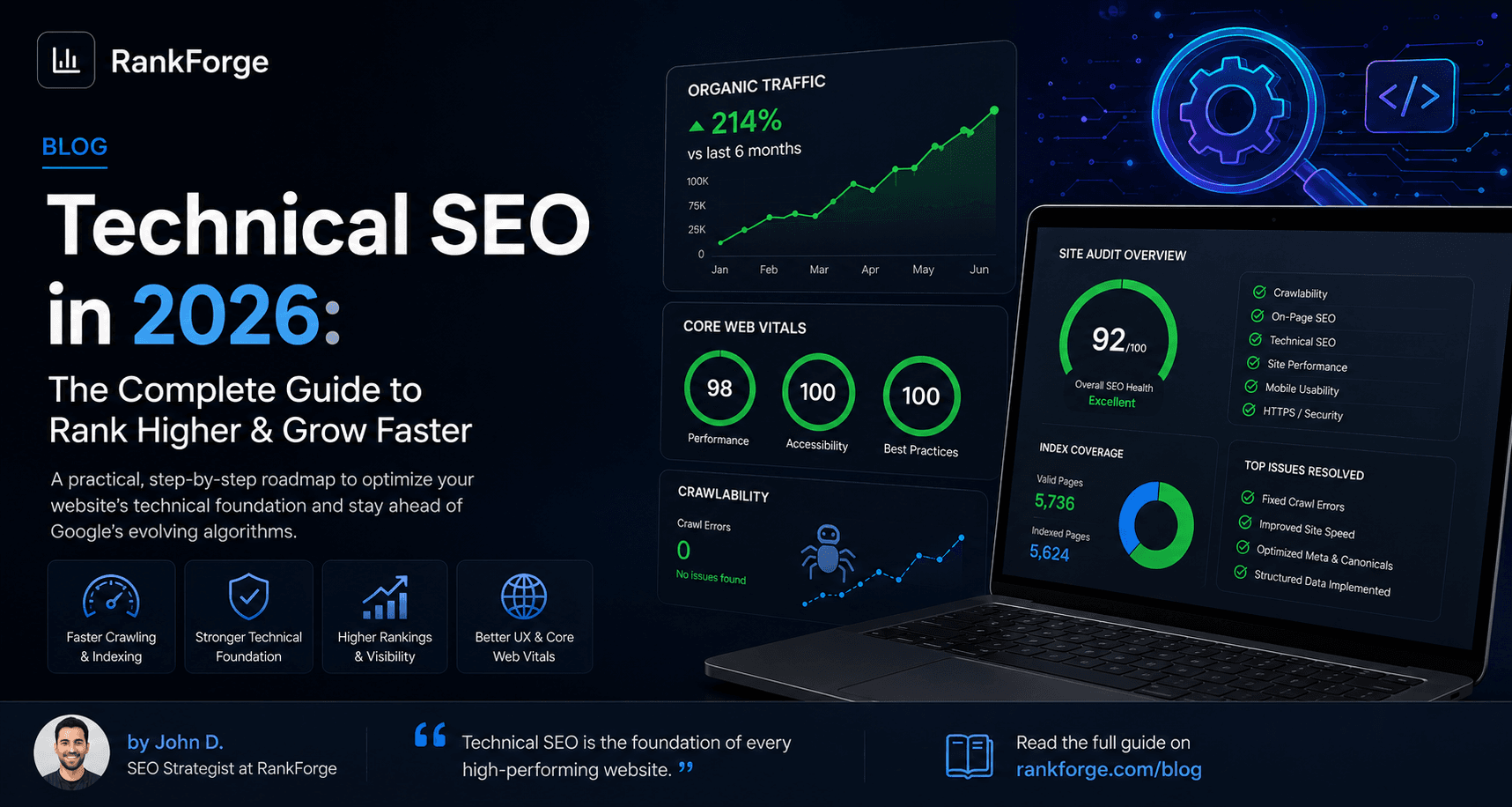
What Is a Technical SEO Audit?
Technical SEO is the foundation of a website's organic visibility. It focuses on optimizing the technical elements that help search engines crawl, render, index, and understand your pages efficiently. Without a solid technical foundation, even the best content and strongest backlink profile may struggle to achieve sustainable rankings in Google Search, AI Overviews, and other modern search experiences.
Unlike on-page SEO, which focuses on content optimization, or off-page SEO, which focuses on authority and backlinks, Technical SEO ensures that search engines can actually access and understand your website.
If you're looking for expert implementation, explore our Technical SEO Services to see how RankForge helps businesses build stronger technical foundations for sustainable organic growth.
Technical SEO is not about chasing every warning inside an audit tool. It is about fixing the issues that have the greatest impact on crawlability, indexation, user experience, and business growth.
Complete Checklist to Improve Crawlability & Indexing
Technical SEO has become more important than ever in 2026. Google increasingly relies on page experience, structured data, semantic understanding, Core Web Vitals, and AI-powered systems to evaluate websites.
A modern technical SEO audit should answer questions such as:
- Can Google crawl the site efficiently?
- Are important pages indexed?
- Are duplicate pages controlled?
- Does the website load quickly?
- Does structured data validate correctly?
- Is the site optimized for AI-powered search experiences?
Technical SEO works best when combined with a strong On-Page SEO strategy, valuable content, and high-quality backlinks. Together, these disciplines create a scalable SEO strategy capable of supporting long-term growth.
score = (business_value * ranking_gap) / implementation_effortCrawlability & Indexability
The first step of every technical SEO audit is ensuring search engines can properly crawl and index your website.
Google Search Console remains one of the most valuable free tools for identifying crawl errors, excluded URLs, index coverage issues, and sitemap status. Review your reports regularly using Google Search Console.
A crawl and indexation review should include:
- Robots.txt validation
- XML sitemap review
- Index Coverage report
- Crawl errors
- Soft 404 pages
- Orphan pages
- Noindex directives
- Canonical conflicts
A page that cannot be crawled or indexed cannot generate organic traffic regardless of how good its content may be.
Robots.txt
Your robots.txt file controls which sections of your website search engines can access.
Although robots.txt is a relatively small file, mistakes can have serious SEO consequences. Accidentally blocking CSS files, JavaScript resources, images, or entire sections of your website may prevent Google from rendering pages correctly.
Always verify robots.txt after migrations, redesigns, or CMS updates.
Google provides detailed guidance in its Robots.txt documentation.
A healthy robots.txt file should:
- Block only private areas
- Allow important resources
- Reference your XML sitemap
- Avoid unnecessary complexity
Small configuration mistakes can lead to significant crawl inefficiencies.
XML Sitemap
An XML sitemap acts as a roadmap for search engines by listing the URLs you want indexed.
Every SEO audit should verify that the sitemap:
| Check | Status |
|---|---|
| Contains canonical URLs | ✅ |
| Excludes redirects | ✅ |
| Excludes noindex pages | ✅ |
| Updates automatically | ✅ |
| Submitted to Search Console | ✅ |
Review the official XML Sitemap protocol for implementation best practices.
An optimized sitemap helps search engines discover newly published content faster while improving crawl efficiency, especially for large websites.
Canonical Tags
Canonical tags help search engines understand which version of similar or duplicate pages should be indexed. Incorrect canonical implementation can dilute ranking signals, waste crawl budget, and cause important pages to disappear from search results.
Common canonical issues include:
- Multiple pages pointing to themselves incorrectly
- Canonicalizing to non-indexable URLs
- Conflicting canonical and noindex directives
- Missing canonical tags on duplicate content
- HTTP and HTTPS canonical mismatches
Always verify canonical implementation after website migrations or URL changes. Google's Canonicalization Documentation explains how search engines evaluate duplicate content.
A properly implemented canonical strategy helps consolidate authority while preventing duplicate indexing issues.
Redirects
Redirects preserve both user experience and SEO equity during website updates, redesigns, and migrations. Every redirect should have a clear purpose and send both users and search engines to the most relevant destination.
During every technical audit, check for:
- 301 redirects that should replace temporary 302 redirects
- Redirect chains
- Redirect loops
- Broken destination URLs
- Internal links pointing to redirected pages
A healthy redirect strategy improves crawl efficiency and protects accumulated ranking signals.
Every unnecessary redirect wastes crawl budget and increases page loading time. The best redirect is often the one you don't need because internal links already point directly to the final destination.
Internal Linking
Internal linking is one of the most overlooked aspects of Technical SEO. It distributes authority throughout your website while helping users and search engines discover related content.
Every important page should be reachable within three to four clicks from the homepage.
A strong internal linking strategy includes:
- Contextual links between related articles
- Links from blog posts to service pages
- Breadcrumb navigation
- Related resources
- Clear site hierarchy
For example, if you're learning about audits, you may also benefit from our Technical SEO Services, On-Page SEO, or SEO Services.
Strong internal linking helps Google understand topical relationships while improving user engagement and crawl efficiency.
Core Web Vitals
Core Web Vitals measure real user experience using three primary metrics:
| Metric | Recommended |
|---|---|
| Largest Contentful Paint (LCP) | Less than 2.5 seconds |
| Interaction to Next Paint (INP) | Less than 200 ms |
| Cumulative Layout Shift (CLS) | Less than 0.1 |
You can evaluate your website using Google PageSpeed Insights.
Improving Core Web Vitals often involves:
- Optimizing images
- Reducing JavaScript
- Implementing lazy loading
- Improving server response times
- Eliminating render-blocking resources
- Optimizing fonts
A fast website improves both user satisfaction and long-term organic performance.
JavaScript SEO
Many modern websites rely heavily on JavaScript, but improperly rendered content can prevent search engines from fully understanding important information.
A Technical SEO audit should verify:
- Server-side rendering (SSR)
- Static site generation (SSG)
- Client-side rendering
- Hydration
- Lazy-loaded content
- Infinite scrolling
- JavaScript-generated links
Example:
<link rel="canonical" href="https://rankforge-agency.com/blog/technical-seo-audit-checklist" />Google has become much better at rendering JavaScript, but relying entirely on client-side rendering can still delay indexing and reduce crawl efficiency. When possible, ensure important content is available during the initial HTML response rather than requiring JavaScript execution.
Structured Data
Structured data provides additional context about your pages using Schema.org vocabulary. Proper schema implementation can improve eligibility for rich results, knowledge panels, AI-generated answers, and enhanced search listings.
Every technical SEO audit should validate structured data using Google's Rich Results Test before deployment.
The most commonly implemented schema types include:
- Organization
- Local Business
- Service
- Article
- FAQ
- Breadcrumb
- Review
- Person
Proper structured data helps search engines understand your content more accurately while improving eligibility for enhanced search features and AI-powered search experiences.
Structured data does not guarantee rich results, but incorrect schema almost guarantees you won't receive them.
Open Graph
Open Graph metadata controls how your content appears when shared across Facebook, X, LinkedIn, WhatsApp, and many other social platforms.
A well-optimized Open Graph implementation should include:
- Unique page title
- Compelling description
- High-quality featured image
- Canonical URL
- Correct page type
Every important page should also include Twitter Card metadata to ensure consistent previews across social platforms.
Although Open Graph is not a direct ranking factor, attractive previews often increase click-through rates, improve brand consistency, and encourage more social sharing.
Schema Markup
Schema Markup strengthens your website's semantic understanding by explicitly describing organizations, services, articles, FAQs, breadcrumbs, reviews, and local business information.
Google increasingly relies on structured entities rather than keywords alone. A complete schema implementation helps search engines connect your business with relevant topics, products, services, and locations.
At RankForge we integrate structured data into our Technical SEO Services to help businesses improve search visibility across Google, AI Overviews, and emerging AI search platforms.
Learn more about Schema vocabulary on Schema.org.
Mobile SEO
Mobile SEO ensures your website performs consistently across smartphones and tablets where most searches now occur.
A mobile-friendly website should provide:
- Responsive layouts
- Fast page loading
- Readable typography
- Touch-friendly navigation
- Optimized images
- Stable layouts with low CLS
Google now uses mobile-first indexing, meaning the mobile version of your website is considered the primary version for ranking and indexing.
Businesses targeting geographic markets should combine strong technical optimization with our Local SEO Services to maximize local visibility and improve performance across Google Maps and local search.
Technical SEO Tools
Professional technical SEO audits combine multiple tools to provide a complete understanding of your website's health.
| Tool | Primary Purpose |
|---|---|
| Google Search Console | Crawl & Indexing |
| Screaming Frog | Website Crawling |
| Sitebulb | Technical Audits |
| Ahrefs | Backlinks |
| Semrush | Site Audit |
| Google Lighthouse | Performance |
| Google PageSpeed Insights | Core Web Vitals |
| Rich Results Test | Structured Data Validation |
No single SEO tool provides every answer. Combining multiple trusted tools allows SEO professionals to identify crawlability issues, indexation problems, performance bottlenecks, duplicate content, structured data errors, and opportunities for long-term organic growth more effectively.
Common Technical SEO Mistakes
Even experienced website owners make technical SEO mistakes that quietly reduce organic visibility. The good news is that most issues can be identified and resolved through regular technical audits.
Some of the most common problems include:
- Broken internal links
- Duplicate content
- Missing or incorrect canonical tags
- Slow page speed
- Invalid structured data
- Poor redirect management
- Orphan pages
- Blocked JavaScript or CSS resources
- Missing XML sitemaps
- Incorrect robots.txt directives
- Large images without optimization
- Missing image alt text
- Mobile usability issues
- Excessive redirect chains
- Soft 404 pages
Many of these problems go unnoticed for months and gradually reduce rankings, crawl efficiency, and user experience. Regular technical audits help identify these issues before they become costly SEO problems.
A successful Technical SEO Audit should prioritize issues based on business impact rather than simply producing a long export from an SEO tool.
Use the following checklist during every audit:
Technical SEO Audit Checklist
- ✅ Verify robots.txt
- ✅ Validate XML Sitemap
- ✅ Review Google Search Console coverage
- ✅ Check crawl errors
- ✅ Review canonical tags
- ✅ Fix redirect chains
- ✅ Improve internal linking
- ✅ Optimize Core Web Vitals
- ✅ Validate structured data
- ✅ Review Open Graph metadata
- ✅ Check mobile usability
- ✅ Optimize page speed
- ✅ Compress images
- ✅ Improve website architecture
- ✅ Fix broken internal links
- ✅ Review HTTPS implementation
- ✅ Monitor crawl budget
- ✅ Validate schema markup
- ✅ Review indexation reports
For businesses looking for expert implementation, our Technical SEO Services help prioritize and resolve the issues that have the greatest impact on long-term organic growth.
Conclusion
Technical SEO is not a one-time task—it is an ongoing process of monitoring, improving, and adapting your website as search engines evolve. Google's algorithms, Core Web Vitals, structured data requirements, and AI-powered search experiences continue to change, making regular technical audits more important than ever.
By combining crawlability improvements, optimized website architecture, structured data, fast page speed, strong internal linking, and excellent user experience, businesses can build a sustainable SEO strategy capable of generating long-term organic growth.
Remember, successful SEO is built on a solid technical foundation. Every improvement you make today creates a stronger platform for future content, backlinks, and business growth.
Frequently Asked Questions
What is Technical SEO?
Technical SEO focuses on improving the technical health of a website so search engines can crawl, render, index, and understand its content efficiently.
How often should I perform a Technical SEO Audit?
Most websites should perform a comprehensive technical audit every 3–6 months, or immediately after major website updates or migrations.
Does Technical SEO improve rankings?
Technical SEO provides the foundation for higher rankings by improving crawlability, indexation, website performance, and user experience. While content and backlinks remain essential, technical optimization allows search engines to evaluate your pages more effectively.
Which free Technical SEO tools should I use?
We recommend:
- Google Search Console
- Google PageSpeed Insights
- Rich Results Test
- Google Lighthouse
What's the difference between Technical SEO and On-Page SEO?
Technical SEO focuses on website infrastructure, while On-Page SEO focuses on optimizing content, headings, keywords, and user intent.
Is Technical SEO important for Local SEO?
Absolutely. Businesses investing in Local SEO Services should first ensure their websites have a strong technical foundation to maximize local rankings and user experience.
Ready to Improve Your Website's Technical SEO?
Whether you're struggling with crawl errors, indexation issues, slow Core Web Vitals, structured data problems, or AI Search readiness, RankForge can help.
Our Technical SEO audits include:
- ✅ Complete crawl analysis
- ✅ Indexation review
- ✅ Core Web Vitals optimization
- ✅ Structured data validation
- ✅ Internal linking recommendations
- ✅ Website architecture review
- ✅ AI Search Optimization
- ✅ Prioritized implementation roadmap
Explore our Technical SEO Services, browse our Resources, or book your free strategy call to receive a tailored roadmap for improving your website's organic visibility, technical performance, and long-term search growth.
Ready to turn this into a roadmap?
RankForge can audit your site, prioritize the best opportunities, and build the growth system behind them.
Request free audit