Google AI Overviews & AI Mode SEO: 12 Practical Ways to Improve Your Visibility in 2026
Learn 12 practical ways to improve your website's visibility in Google AI Overviews and AI Mode using proven SEO fundamentals.
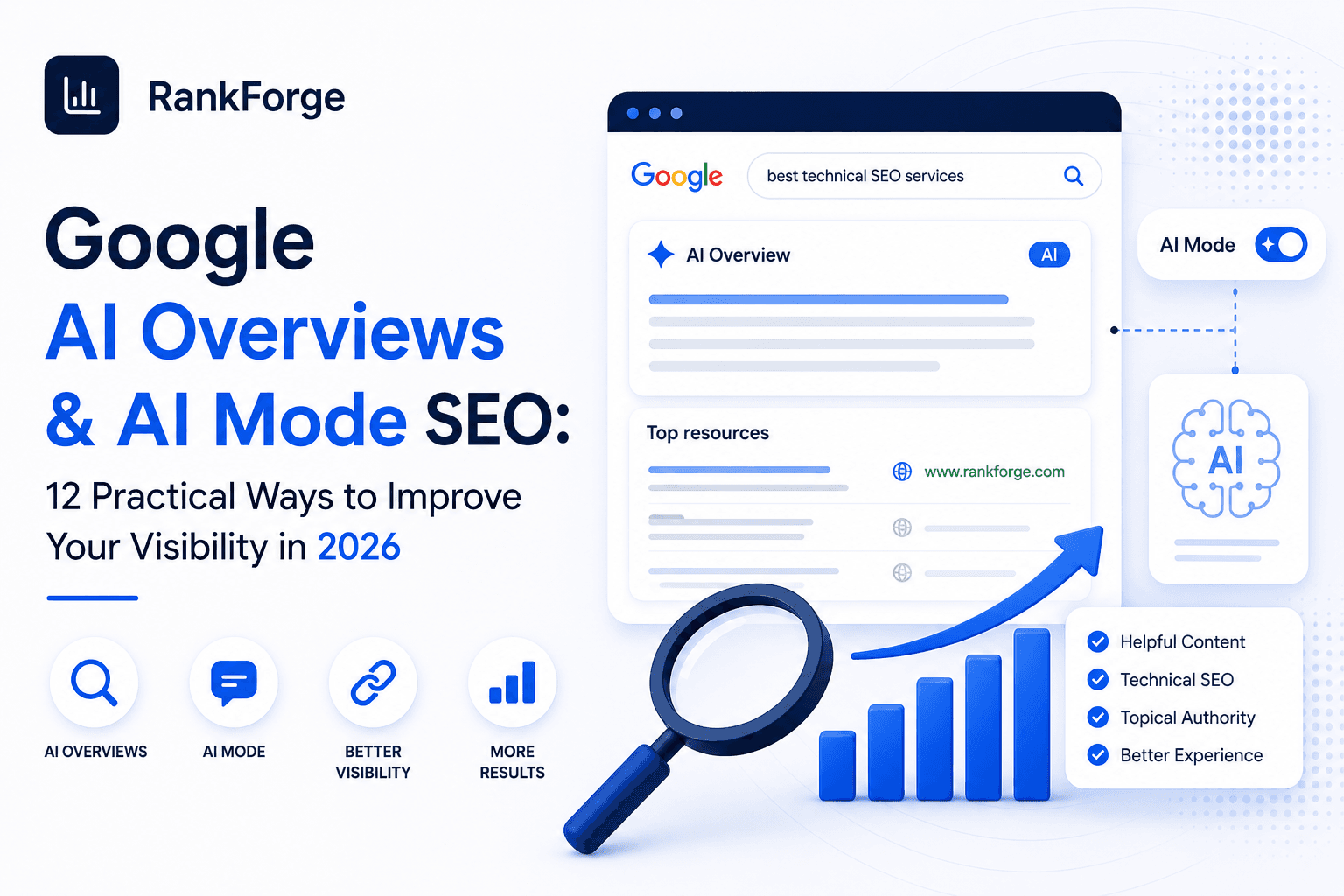
Google AI Overviews & AI Mode SEO: 12 Practical Ways to Improve Your Visibility in 2026
Google Search is no longer limited to a list of blue links.
AI Overviews and AI Mode can summarize information, explore related questions, compare options, and provide links to supporting websites. For businesses, this creates a new visibility opportunity — but it does not require abandoning traditional SEO.
Google's own guidance is clear: the SEO fundamentals that help pages perform in Search also provide the foundation for visibility in generative AI features.
The practical goal is simple:
Create content that Google can crawl, understand, trust, and confidently surface when users ask complex questions.
This guide explains 12 practical ways to improve your website's readiness for Google AI Overviews and AI Mode in 2026.
What Are Google AI Overviews and AI Mode?
Google AI Overviews provide an AI-generated summary for certain searches and include links to supporting web resources.
AI Mode goes further by allowing users to explore questions conversationally and ask follow-up questions. Google explains that AI Mode can use multiple related searches across different subtopics to build a more comprehensive response.
This means a single user question can involve several related search intents.
For example, someone searching:
"How much does technical SEO cost for a small business?"
could also be interested in:
- What does a technical SEO audit include?
- How long does technical SEO take?
- What technical SEO problems affect rankings?
- Should a small business hire an SEO agency?
- How do you measure technical SEO results?
A strong website should be able to answer the broader topic, not just one isolated keyword.
score = (business_value * ranking_gap) / implementation_effortDoes Traditional SEO Still Matter for AI Overviews?
Yes.
Google's current documentation states that its generative AI search features are rooted in its existing Search ranking and quality systems.
There are also no special technical requirements that guarantee inclusion in AI Overviews or AI Mode.
Instead, pages need to meet the normal technical requirements for Google Search and be eligible to appear with a snippet.
That means your foundation still matters:
- Crawlability
- Indexability
- Helpful content
- Internal linking
- Page experience
- Structured data
- Clear site architecture
- Strong topical coverage
- Reliable information
For businesses investing in AI search visibility, the biggest mistake is treating AEO as a replacement for SEO.
It is better understood as an extension of modern SEO.
12 Ways to Improve AI Overview and AI Mode Visibility
1. Make Sure Google Can Crawl Your Important Pages
AI search cannot reliably use content that Google cannot access.
Start with the basics:
- Check robots.txt.
- Make sure important pages return HTTP 200 responses.
- Remove accidental noindex directives.
- Check canonical URLs.
- Submit an accurate XML sitemap.
- Make important pages discoverable through internal links.
- Test important URLs with Google Search Console.
For larger websites, crawl efficiency also becomes important because unnecessary URLs can consume crawling resources.
Your technical foundation should be checked before investing heavily in AI-search content.
If you need a broader technical review, see our Technical SEO Audit Checklist.
2. Put Important Information in Crawlable Text
Do not make your most important information dependent entirely on images, animations, or client-side interactions.
Google can process JavaScript, but important content should still be available in a format that search systems can reliably access and understand.
For service pages, clearly explain:
- What the service does
- Who it is for
- What is included
- How the process works
- What results can realistically be expected
- How pricing or engagement works
- What makes your approach different
This makes the page useful for humans and easier for search systems to interpret.
3. Answer the Main Question Early
AI search users often want an answer quickly.
Do not make visitors read five paragraphs before discovering the actual answer.
A strong structure is:
- Direct answer
- Explanation
- Evidence
- Examples
- Implementation steps
- Related questions
For example:
What is AI search optimization?
AI search optimization is the process of improving a website's content, technical accessibility, authority, and structure so AI-powered search systems can understand and potentially surface the website in relevant answers.
Then expand the topic.
This structure benefits users without requiring artificial "AI-friendly" writing.
4. Build Topic Depth Instead of Publishing Isolated Articles
One article rarely establishes strong topical authority.
Instead, create connected content around an important business topic.
For example, an AI search cluster could include:
- Answer Engine Optimization
- Google AI Overviews
- Google AI Mode
- Generative AI search
- AI search measurement
- Entity SEO
- Structured data
- Technical SEO
- Topical authority
- Core Web Vitals
Then connect these pages with contextual internal links.
Your Answer Engine Optimization guide is a natural supporting resource for this topic.
The goal is to create a knowledge system rather than a collection of disconnected blog posts.
5. Use Internal Links to Establish Relationships
Internal links help users discover related information and help search engines understand how your pages relate to one another.
A good AI-search content structure might look like:
AI Search Optimization
→ AEO Guide → Google AI Overviews → AI Mode → AI Search Measurement → Entity SEO → Technical SEO → Structured Data
Use descriptive anchor text rather than generic phrases such as "click here" or "read more."
For example:
Better:
learn how Answer Engine Optimization works
Weaker:
Internal linking should feel natural and help the reader continue their research.
6. Create Non-Commodity Content
Google's latest generative AI guidance places strong emphasis on useful, unique, people-first content.
That means simply rewriting the same information already published by hundreds of websites is unlikely to create a durable advantage.
Add something original:
- First-hand observations
- Original examples
- Data
- Case studies
- Screenshots
- Expert analysis
- Comparisons
- Practical frameworks
- Lessons from real projects
Ask:
What does this page provide that another generic AI-generated article does not?
That question is increasingly important in AI search.
7. Strengthen Entity Signals
AI systems need to understand entities and relationships.
Your website should clearly communicate:
- Who your company is
- What services you provide
- Which industries you serve
- Who your authors are
- Where you operate
- Which topics you specialize in
- Which pages support each other
Keep business information consistent across your website and important external profiles.
For local businesses, also keep Google Business Profile information accurate and up to date.
Entity clarity becomes particularly valuable when users ask recommendation or comparison questions.
8. Use Structured Data Correctly
Structured data can help search engines understand the content and entities represented on a page.
But there is an important distinction:
Structured data is not an AI ranking shortcut.
Google does not require special "AI schema" to appear in AI Overviews or AI Mode.
Instead, use structured data where it accurately represents the visible page content.
Depending on the page, this may include:
- Article
- Organization
- LocalBusiness
- BreadcrumbList
- Product
- Other appropriate Schema.org types
Never add markup simply because you think an AI system will reward it.
The markup should describe the page accurately.
9. Improve Page Experience and Core Web Vitals
AI visibility does not make performance irrelevant.
Users still need to successfully access and interact with your website after clicking a supporting result.
Review:
- Largest Contentful Paint
- Interaction to Next Paint
- Cumulative Layout Shift
- Mobile performance
- Image sizes
- JavaScript
- Third-party scripts
- Font loading
- Render-blocking resources
Our Core Web Vitals 2026 guide explains how to diagnose and improve these areas.
A fast page is not automatically an AI-search winner, but poor technical performance can create unnecessary friction after discovery.
10. Support Text With Useful Images and Other Media
Search is increasingly multimodal.
Google's guidance recommends supporting textual content with high-quality images and videos where appropriate.
For example, a technical SEO article could include:
- Crawl diagrams
- Search Console screenshots
- Audit examples
- Architecture diagrams
- Before-and-after performance examples
- Process illustrations
The important part is relevance.
Do not add decorative images simply to make an article longer.
Use media when it improves understanding.
11. Measure AI Visibility With Search Console
Measurement is one of the biggest changes in AI search.
Google has introduced a Generative AI performance report in Search Console for eligible properties.
The report can provide information about impressions from generative AI features and can show which pages receive visibility.
Access is still being rolled out to some website owners, so not every property will necessarily see the report yet.
When available, monitor:
- Generative AI impressions
- Pages receiving AI visibility
- Device
- Country
- Trends over time
Do not judge AI-search performance using clicks alone.
A user might discover your brand through an AI result, remember the brand, and return later through branded search or direct traffic.
That is why AI visibility should be evaluated alongside:
- Organic clicks
- Branded searches
- Leads
- Conversions
- Assisted conversions
- Engagement
- Returning visitors
For a deeper measurement workflow, read our Google Search Console AI Search Report guide.
12. Keep Important Content Fresh
AI search is particularly sensitive to questions where freshness matters.
Review pages that cover:
- SEO tools
- Google products
- Search features
- Pricing
- Regulations
- Software
- Statistics
- Industry changes
- Best practices
Do not update an article merely to change the publication date.
Improve the actual information.
Replace outdated screenshots, remove obsolete recommendations, add new evidence, and explain what changed.
A useful update is better than a cosmetic update.
What You Do NOT Need for Google AI Overviews
The AI-search industry has produced many claims about secret optimization techniques.
Be careful.
Google's current guidance says you do not need:
- Special AI schema
- A special AI-only HTML format
- An "AI ranking" meta tag
- Artificial content chunking
- Large numbers of automatically generated pages
- Keyword stuffing
- Fake mentions
- Unnecessary AI files created specifically to influence Google Search
Google has also clarified that llms.txt is not required for Google Search and does not provide a positive or negative ranking effect.
The practical strategy is much simpler:
Build a technically strong website with genuinely useful information.
How AI Mode Changes Content Strategy
AI Mode makes content strategy more interesting because users can continue asking questions.
A user might begin with:
"What is technical SEO?"
Then ask:
"What should I check first?"
Then:
"What tools should I use?"
Then:
"How much does an audit cost?"
This creates a chain of related intents.
Your content should therefore answer the primary topic while naturally covering the important follow-up questions around it.
This does not mean creating hundreds of pages for every possible question.
Instead, organize related questions into useful resources.
One strong guide can often be better than twenty thin articles.
AI Search SEO Checklist
Before publishing an important page, ask:
Technical
- Is the page indexable?
- Can Google crawl it?
- Is the canonical URL correct?
- Is it included in the sitemap where appropriate?
- Are important links crawlable?
- Does the page work well on mobile?
Content
- Does the page answer a real user need?
- Is the main answer easy to find?
- Does the content add something original?
- Are claims supported?
- Are examples useful?
- Is the information current?
Internal linking
- Does another relevant page link to this page?
- Does this page link to related resources?
- Are anchor texts descriptive?
- Is the page connected to the appropriate service or category?
AI-search readiness
- Are important facts available as text?
- Are entities clearly defined?
- Does structured data match visible content?
- Are images relevant and high quality?
- Is the content useful for follow-up questions?
Measurement
- Is the URL tracked in Search Console?
- Can you compare organic performance over time?
- Are conversions configured?
- Are branded-search changes being monitored?
- Is AI visibility available in your Search Console property?
Frequently Asked Questions
Can I optimize specifically for Google AI Overviews?
You can optimize your website for the conditions that support visibility, but there is no guaranteed AI Overview ranking technique. Google recommends continuing to follow its foundational SEO and content guidelines.
Does AI Mode replace traditional Google Search?
No. AI Mode is a different search experience that allows deeper conversational exploration. Traditional Search and AI features continue to coexist.
Do I need special schema for AI Overviews?
No. Google says there is no special Schema.org markup required specifically for AI Overviews or AI Mode. Use structured data when it accurately represents visible content.
Does AEO replace SEO?
No. AEO is best treated as an extension of SEO for answer-based and AI-powered search experiences.
Does Google Search Console show AI Overview traffic?
Google's reporting methodology includes AI features within Search Console, and Google is also rolling out a dedicated Generative AI performance report to eligible properties. Availability can vary by property.
Is llms.txt required for Google AI search?
No. Google states that llms.txt is not required for Google Search and does not affect Google Search visibility or rankings.
Conclusion
Google AI Overviews and AI Mode are changing how people discover information, but the fundamentals behind successful search visibility remain surprisingly familiar.
The strongest strategy is not to chase an AI-specific trick.
It is to build a website that is:
- Crawlable
- Indexable
- Fast
- Well structured
- Internally connected
- Entity-aware
- Technically sound
- Helpful
- Original
- Trustworthy
Then measure what happens.
As AI search continues to evolve, the businesses with the strongest foundations will have more opportunities to appear wherever their customers are looking for answers.
If your website needs help improving its visibility across Google Search and AI-powered search experiences, explore RankForge's SEO services or AI Search Optimization services.
Ready to turn this into a roadmap?
RankForge can audit your site, prioritize the best opportunities, and build the growth system behind them.
Request free audit