Answer Engine Optimization (AEO): The Complete Guide to Ranking in AI Search & Answer Engines
Learn how Answer Engine Optimization improves AI visibility across Google AI Overviews, ChatGPT, Perplexity, Bing Copilot, and answer engines.
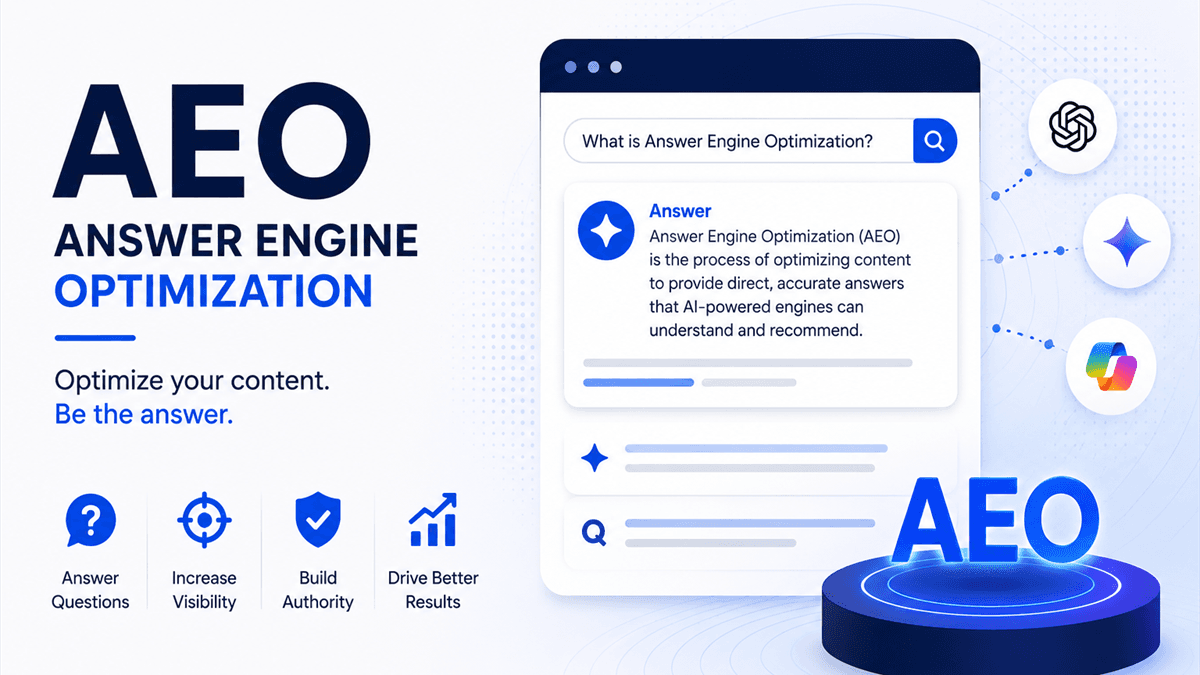
Answer Engine Optimization is the practice of making your brand, content, and website easier for AI search systems to understand, trust, cite, and summarize. It does not replace SEO. It extends modern SEO services into a search environment where users expect direct answers from Google AI Overviews, ChatGPT, Perplexity, Bing Copilot, voice assistants, and other answer engines.
Search is changing because the interface is changing. Instead of typing a short keyword and scanning ten blue links, users now ask full questions, compare options, request summaries, and expect a useful answer immediately. Google describes AI Overviews and AI Mode as search features that help people understand complex questions faster and explore supporting links from the web through AI features in Search. Product availability, behavior, and traffic impact can change by market and query, so treat specific platform statistics as time-sensitive rather than as a permanent planning benchmark.
That shift creates a practical business problem. If your content is technically accessible but vague, generic, thin, or disconnected from trusted entities, answer engines have little reason to use it. If your pages explain topics clearly, support claims, use structured data, build topical authority, and connect to credible brand signals, you improve your chance of being discovered, cited, or recommended.
Featured answer: Answer Engine Optimization helps your content become a trusted source for AI-generated answers by improving clarity, entity signals, structured data, topical depth, technical accessibility, and brand authority.
For RankForge, AEO sits beside Technical SEO, On-Page SEO, Content Writing, and authority building. The goal is not to chase every new AI platform. The goal is to make your expertise easier to retrieve, verify, and quote wherever people search.
What Is Answer Engine Optimization?
Answer Engine Optimization, often shortened to AEO, is the process of optimizing content so answer engines can extract a clear, trustworthy response to a user's question. An answer engine can be a traditional search feature, a voice assistant, a generative AI search result, or a chatbot that retrieves web sources before responding.
AEO grew from the same foundation as SEO. Featured snippets, People Also Ask boxes, knowledge panels, map packs, and voice answers were early signs that search engines wanted direct answers, not only ranked documents. Generative search simply makes that pattern more visible.
A strong Answer Engine Optimization Guide should focus on three outcomes:
- Make the answer easy for humans to understand.
- Make the page easy for crawlers and retrieval systems to access.
- Make the source credible enough to be cited or used as supporting evidence.
AEO is not about writing robotic summaries for machines. It is about creating helpful, precise, well-structured content that satisfies a real intent. In many cases, the best AEO asset is also the best SEO asset: a page with a clear title, strong introduction, useful subheadings, original examples, internal links, schema markup, and verifiable expertise.
RankForge Insight: AEO rewards clarity. If a human reader has to work too hard to find the answer, an AI system usually has to work too hard as well.
The difference is that AEO asks one extra question: could an answer engine confidently quote, summarize, or recommend this page without losing context?
score = (business_value * ranking_gap) / implementation_effortWhy AEO Matters in 2026
AEO matters because users are asking longer, more specific questions and receiving more complete answers directly in the search experience. Google's 2026 AI Mode insights described AI Mode as part of a broader move toward deeper, conversational search, with AI Mode queries more than doubling every quarter since launch.
This does not mean websites are irrelevant. It means visibility is being redistributed. Google says AI features still show supporting links and that clicks from AI features can be higher quality when users do click through. Microsoft also states in its Bing Webmaster Guidelines that SEO fundamentals support visibility across Bing, Copilot, and AI-powered search experiences.
AEO is especially important for businesses that depend on education before conversion:
- Local service businesses that need trust before a call.
- SaaS and B2B companies with complex buying journeys.
- Professional services where expertise matters.
- Healthcare, legal, finance, and home services where accuracy is critical.
- Ecommerce brands where comparison and product-fit questions influence purchase decisions.
Zero click search also changes measurement. A user may discover your brand in an AI Overview, later search your name, then convert from a direct visit or paid campaign. That journey will not always look like a simple organic click.
This is why AEO should be connected to analytics, brand search, assisted conversions, and content quality. It also means technical foundations still matter. If your pages are slow, blocked, poorly linked, or difficult to render, answer engines have less reliable material to work with. Start with a Technical SEO Audit Checklist, then layer AEO improvements on top.
AEO vs Traditional SEO
AEO and SEO overlap, but they are not identical. Traditional SEO often focuses on ranking pages for target queries. AEO focuses on becoming a trusted source for answers, summaries, citations, and recommendations.
| Area | Traditional SEO | Answer Engine Optimization |
|---|---|---|
| Main goal | Rank pages in search results | Earn visibility in AI answers, snippets, citations, and summaries |
| Query style | Short keywords and modifiers | Full questions, comparisons, prompts, and conversational searches |
| Content unit | Page, category, or article | Answer block, entity, section, table, FAQ, and source page |
| Optimization focus | Keywords, links, technical health, content quality | Entities, clarity, structured data, citations, topical authority, and retrievability |
| Success metric | Rankings, clicks, organic traffic | AI visibility, citations, assisted conversions, branded search, qualified clicks |
| User behavior | User chooses from links | User reads an answer first, then may click for depth or proof |
| Structured data | Helps search eligibility and understanding | Helps disambiguate entities, content type, relationships, and page purpose |
| Authority | Backlinks and domain signals | Backlinks, mentions, expertise, entity consistency, author credibility, and proof |
The best strategy is not AEO vs SEO. It is AEO built on strong SEO. A page cannot become a reliable answer source if it is not crawlable, indexable, fast, internally linked, and useful.
For example, a roofing company might use Local SEO to rank in service areas, Off-Page SEO to build authority, and AEO to answer questions like "how much does roof replacement cost in my city" or "how do I compare roofing estimates." That combination supports rankings, AI citations, and conversion.
How AI Search Engines Work
AI search systems vary, but most follow a similar pattern. They interpret the user's question, retrieve relevant information, evaluate sources, generate a response, and often provide supporting links or citations.
A simplified workflow looks like this:
- Query understanding: The system identifies intent, entities, context, location, freshness needs, and follow-up possibilities.
- Retrieval: It searches indexes, knowledge graphs, trusted databases, web pages, or partner sources.
- Source evaluation: It compares authority, relevance, freshness, clarity, and consistency.
- Answer generation: A language model creates a concise response based on retrieved information.
- Citation or link selection: The system may show sources that support the answer or help users go deeper.
Google says AI Mode may use query fan-out, issuing multiple related searches across subtopics and data sources to build a fuller response. OpenAI's publisher and developer guidance explains that public websites can appear in ChatGPT search and that publishers should avoid blocking OAI-SearchBot if they want content discoverable in ChatGPT search.
This is where entity SEO becomes important. Search systems need to understand who you are, what you do, where you operate, what topics you are qualified to discuss, and how your pages relate to each other. A disconnected set of blog posts is weaker than a structured content system connected by internal links, author information, schema, case studies, and clear service pages.
Best Practice: Build your site like a knowledge base, not a pile of isolated articles. Every important topic should connect to services, examples, resources, and proof.
Core Ranking Factors for AEO
There is no single public AEO ranking formula. But practical evidence and search documentation point to a consistent group of factors that improve AI search visibility.
Helpful content
Answer engines need content that actually answers the question. A strong page should define the topic, explain why it matters, show how to implement it, cover exceptions, and provide examples. Google continues to emphasize helpful, reliable, people-first content in its Search Essentials.
EEAT
Experience, Expertise, Authoritativeness, and Trust matter because answer engines need confidence. Add author context, cite authoritative sources, show examples, explain tradeoffs, and avoid unsupported claims.
Entity SEO
Entity SEO helps systems understand the people, services, locations, industries, and concepts connected to your brand. This includes consistent names, schema, internal links, citations, Google Business Profile data, and third-party mentions.
Topical authority
A single article is rarely enough. AEO improves when your website covers a topic cluster deeply. For example, this AEO guide should connect to Technical SEO, On-Page SEO, Content Writing, and related guides such as the Local SEO Playbook.
Crawlability and site speed
AI visibility depends on access. If important content is hidden behind scripts, blocked by robots.txt, slowed by poor Core Web Vitals, or buried without internal links, retrieval becomes harder.
Brand authority and citations
Answer engines look for corroboration. Case studies, reviews, mentions, expert profiles, and consistent business information all help. The RankForge case study library and Law Firm SEO service page give search systems and users useful context beyond generic claims.
Common mistake: Treating AEO as a writing style. It is a full visibility system that combines content, technical SEO, schema, authority, UX, and measurement.
Structured Data for Answer Engines
Structured data does not guarantee rankings or citations, but it helps search systems understand the page. Google says structured data should match the visible content on the page, and its structured data documentation is still the safest reference for eligibility and implementation.
For AEO, structured data should clarify the type of content and the relationships around it.
| Schema type | Best use | AEO value |
|---|---|---|
| Article | Blog posts, guides, research pages | Clarifies headline, author, date, image, section, and publisher |
| FAQPage | Genuine FAQ sections | Helps extract direct question-answer pairs when eligible |
| Organization | Brand identity | Reinforces company name, logo, URL, contact details, and sameAs profiles |
| LocalBusiness | Local companies | Connects location, phone, hours, service area, and business entity data |
| BreadcrumbList | Site hierarchy | Helps systems understand page position and category context |
| HowTo | Step-by-step instructional content | Useful when a process has clear steps and visible instructions |
Use Schema.org vocabulary carefully. Do not mark up content that users cannot see. Do not add fake reviews, fake ratings, or irrelevant schema. Bad structured data can reduce trust instead of improving it.
RankForge already uses structured data across key pages, but schema should always support the content rather than substitute for quality. Think of schema as a label on a well-organized file, not the file itself.
How to Win Featured Snippets
Featured snippets are one of the closest traditional SEO patterns to AEO. They show how search engines extract concise answers from pages and display them above standard results.
To improve snippet eligibility, structure content around answer formats:
- Paragraph snippets: Start a section with a concise definition or direct answer.
- List snippets: Use ordered steps for processes and bullet lists for criteria.
- Table snippets: Compare options, features, costs, pros, cons, or timelines.
- Definition snippets: Define terms in simple language before adding nuance.
A good snippet answer is usually complete enough to satisfy the immediate question, but interesting enough to invite deeper reading. For example, "AEO is the process of optimizing content for answer engines" is useful, but the surrounding section should explain how to do it, when it matters, and how it connects to SEO.
Pro Tip: Write the first 40-60 words under each important heading as if they could stand alone in an AI Overview, voice answer, or featured snippet.
This approach also improves user experience. Readers can scan the page, find the answer, and then decide whether they need the checklist, examples, or implementation details.
Optimizing for ChatGPT
ChatGPT search can surface web results and cite sources when answering timely or web-connected questions. OpenAI's publisher guidance notes that public websites can appear in ChatGPT search and that publishers should make sure OAI-SearchBot is not blocked if they want content discoverable.
Practical ChatGPT SEO starts with accessibility and clarity:
- Allow legitimate crawlers that support search discovery.
- Use descriptive titles and headings.
- Keep important information in visible text, not only in images.
- Publish original explanations, examples, and data.
- Make author, company, and contact information clear.
- Connect related pages with natural internal links.
- Update important guides when facts, tools, or platform behavior changes.
ChatGPT is useful for comparison and recommendation queries, so brands should create pages that answer buying questions. A service business might explain how to choose an SEO partner, what a technical audit includes, how reporting works, and when to use Google Ads alongside organic search. A software company might compare use cases, integrations, pricing models, and implementation risks.
The goal is not to manipulate a model. The goal is to publish material that a retrieval system can find and a language model can summarize accurately.
Optimizing for Google AI Overviews
Google states that there are no special technical requirements to appear in AI Overviews or AI Mode beyond being indexed and eligible for snippets. That is an important point. AEO for Google is not a secret markup trick. It is disciplined SEO with better answers, stronger entities, and cleaner technical execution.
Use this practical framework:
- Confirm eligibility: The page should be indexable, canonicalized correctly, and eligible to show a snippet.
- Answer the main question early: Do not bury the definition or recommendation.
- Cover follow-up questions: Add comparisons, examples, FAQs, and implementation steps.
- Support claims: Link to official sources, original examples, and trustworthy references.
- Strengthen entities: Connect your brand, authors, services, industries, and locations.
- Improve page experience: Fast, readable pages are easier for users and search systems.
- Measure beyond clicks: Track impressions, branded search, assisted conversions, and lead quality.
For local businesses, Google AI visibility also depends on business data. Keep Google Business Profile information accurate, reviews active, and service pages aligned with local intent. The Google Business Profile Optimization Guide covers that foundation in depth.
RankForge Insight: If a page would not deserve to rank in traditional Google Search, it usually does not deserve to be cited in AI Overviews either.
Optimizing for Perplexity
Perplexity is built around answers with sources, which makes citation readiness especially important. Your content should be easy to quote, easy to verify, and useful as a source for a specific question.
Focus on source-worthy content:
- Clear definitions with context.
- Comparison tables that reduce ambiguity.
- Original frameworks and checklists.
- Statistics with credible attribution.
- Pages updated when the topic changes.
- Strong author and publisher signals.
- Internal links to related expert resources.
Perplexity-style searches often feel like research sessions. A user may ask for the best approach, the risks, a comparison, or a concise explanation with sources. That means thin sales pages are weak candidates. Educational content, guides, case studies, and original resources are stronger.
For example, a user comparing SEO and paid search may benefit from a practical audit article such as How to Find Wasted Spend in Google Ads. A user comparing local growth strategies may need the Local SEO Playbook plus a service page that explains implementation.
AEO for Perplexity is not about repeating the same keyword. It is about being the page a researcher would be comfortable citing.
Optimizing for Bing Copilot
Bing Copilot visibility starts with Bing fundamentals. Microsoft advises website owners to focus on technical quality, clarity, accessibility, and non-manipulative SEO practices in the Bing Webmaster Guidelines.
For practical Bing Copilot SEO, prioritize:
- Clean indexation through Bing Webmaster Tools.
- Accurate XML sitemaps.
- Fast, accessible pages.
- Descriptive titles and headings.
- Entity clarity around brand, services, authors, and locations.
- Useful content that directly answers the query.
- Avoidance of manipulative or low-quality tactics.
Bing is also important because Microsoft products use Bing-powered web search in several AI experiences. That means Bing visibility can influence discovery beyond the standard search results page.
If your brand has focused only on Google, add Bing checks to your regular Technical SEO workflow. Submit sitemaps, check crawl errors, review index coverage, and compare how Bing interprets your most important pages.
Best Practice: Treat Bing as a serious AI visibility channel, not an afterthought. Copilot makes Bing's index more strategically important for B2B, enterprise, and research-heavy audiences.
Common AEO Mistakes
Most AEO failures come from weak fundamentals dressed up as advanced strategy. Avoid these common mistakes:
- Writing vague introductions. Start with the answer, then expand.
- Chasing AI keywords without expertise. AEO needs useful substance, not trend language.
- Ignoring technical SEO. Blocked, slow, or poorly rendered pages are harder to retrieve.
- Using schema that does not match the page. Structured data should describe visible content.
- Publishing isolated posts. Build topic clusters with internal links and supporting pages.
- Forgetting entity consistency. Brand names, authors, addresses, services, and social profiles should align.
- Making every section promotional. Answer engines prefer helpful information over sales copy.
- Skipping examples. Examples help users and models understand context.
- Letting content go stale. AI search topics change quickly; update important guides.
- Measuring only last-click traffic. AI visibility can influence branded search, direct visits, and assisted conversions.
- Blocking useful crawlers accidentally. Review robots.txt before assuming a platform can access your pages.
- Using generic AI content. Commodity articles are easy to summarize and easy to ignore.
The fix is straightforward but demanding: build technically sound, deeply useful, well-connected content that earns trust over time. If your team needs a starting point, the SEO checklist, landing page audit, and monthly growth memo can help organize the first pass.
Actionable AEO Checklist
Use this checklist when updating an existing page or planning a new one.
Content clarity
- Answer the main question in the first paragraph.
- Add definitions, examples, steps, and comparison tables.
- Keep paragraphs short and scannable.
- Use FAQs for real follow-up questions.
- Include original insight, not only summaries of other pages.
Technical readiness
- Confirm the page is indexable.
- Check canonical tags.
- Make important content visible in HTML.
- Improve Core Web Vitals and mobile usability.
- Add internal links from relevant pages.
- Validate structured data.
Authority signals
- Show author or editorial responsibility.
- Link to official sources where relevant.
- Add proof through case studies, examples, reviews, or data.
- Keep brand profiles consistent.
- Update outdated pages.
Measurement
- Track Search Console performance.
- Monitor branded searches.
- Review referral traffic from AI platforms where available.
- Measure assisted conversions and lead quality.
- Compare visibility across Google, Bing, ChatGPT, and Perplexity.
AEO works best when it becomes part of your publishing process. Briefs, outlines, drafts, technical QA, schema, internal links, and reporting should all account for answer visibility.
Future of Answer Engine Optimization
The future of AEO will be shaped by AI agents, personalization, conversational interfaces, and deeper integrations between search, browsers, assistants, and commerce. Users will ask fewer disconnected queries and more complex tasks: compare vendors, plan a project, shortlist options, estimate cost, summarize reviews, and recommend next steps.
That does not make websites less important. It makes trustworthy source material more important. AI systems still need crawlable pages, structured information, credible brands, current details, and original insight.
Several trends are already visible:
- AI agents will complete more research before users visit a website.
- Brand mentions and third-party validation will matter more.
- Content freshness will become harder to fake.
- Local entity data will influence more recommendations.
- Product, service, pricing, and availability data will need to be clearer.
- Helpful content will need to serve both humans and retrieval systems.
The brands that win will not be the ones that publish the most pages. They will be the ones that become the easiest trusted answer for the questions their buyers actually ask.
Frequently Asked Questions
What is Answer Engine Optimization?
Answer Engine Optimization is the process of optimizing content, technical signals, structured data, and authority so AI search systems can understand, trust, cite, and summarize your website in direct answers.
Is AEO different from SEO?
Yes, but they overlap. SEO focuses on organic visibility in search results. AEO focuses on visibility in direct answers, AI summaries, featured snippets, citations, and conversational search responses.
Does AEO replace traditional SEO?
No. AEO depends on strong SEO foundations such as crawlability, indexation, helpful content, internal linking, site speed, structured data, and authority.
How do I optimize for Google AI Overviews?
Make pages indexable, answer questions clearly, cover follow-up intent, use accurate structured data, improve page experience, cite reliable sources, and build topical authority around the subject.
How do I optimize for ChatGPT search?
Ensure public pages are crawlable, avoid blocking relevant search crawlers, publish clear source-worthy content, use strong headings, show author credibility, and keep important information visible in text.
What content works best for AEO?
Definitions, comparison tables, FAQs, checklists, step-by-step frameworks, case studies, original examples, expert explanations, and pages that answer specific buyer questions tend to work well.
Is structured data required for AEO?
Structured data is not a guarantee, but it helps search systems understand page type, author, organization, breadcrumbs, FAQs, local business details, and content relationships.
Can local businesses benefit from AEO?
Yes. Local businesses can improve AI visibility by strengthening Google Business Profile data, reviews, location pages, local FAQs, service pages, citations, and clear contact information.
How should AEO success be measured?
Measure rankings, impressions, AI referrals where available, branded search growth, direct visits, assisted conversions, lead quality, and visibility across Google, Bing, ChatGPT, and Perplexity.
What is the biggest AEO mistake?
The biggest mistake is treating AEO as keyword stuffing for AI. The better approach is to publish helpful, credible, technically accessible content that answer engines can confidently use as a source.
Conclusion
Answer Engine Optimization is the next layer of serious organic growth. It does not replace technical SEO, content strategy, local SEO, or authority building. It connects them to the way people now search: conversationally, quickly, and with help from AI systems that summarize the web.
The practical path is clear. Make your site crawlable. Answer important questions directly. Build entities and topical authority. Use structured data correctly. Support claims with trustworthy sources. Keep content fresh. Measure visibility beyond last-click traffic.
Businesses that adapt early will have an advantage because AEO compounds. Every useful guide, service page, FAQ, case study, and resource improves the larger knowledge system around the brand.
If you want a clearer plan, start with RankForge. Explore our SEO services, review the free Resources, or request a strategy call so we can identify where your business is missing visibility in Google, AI Overviews, ChatGPT, Perplexity, Bing Copilot, and the next generation of answer engines.
Ready to turn this into a roadmap?
RankForge can audit your site, prioritize the best opportunities, and build the growth system behind them.
Request free audit