Local SEO Guide for Service Businesses
Learn Local SEO strategies to improve Google Maps rankings, optimize your Google Business Profile, attract local customers, and grow leads.
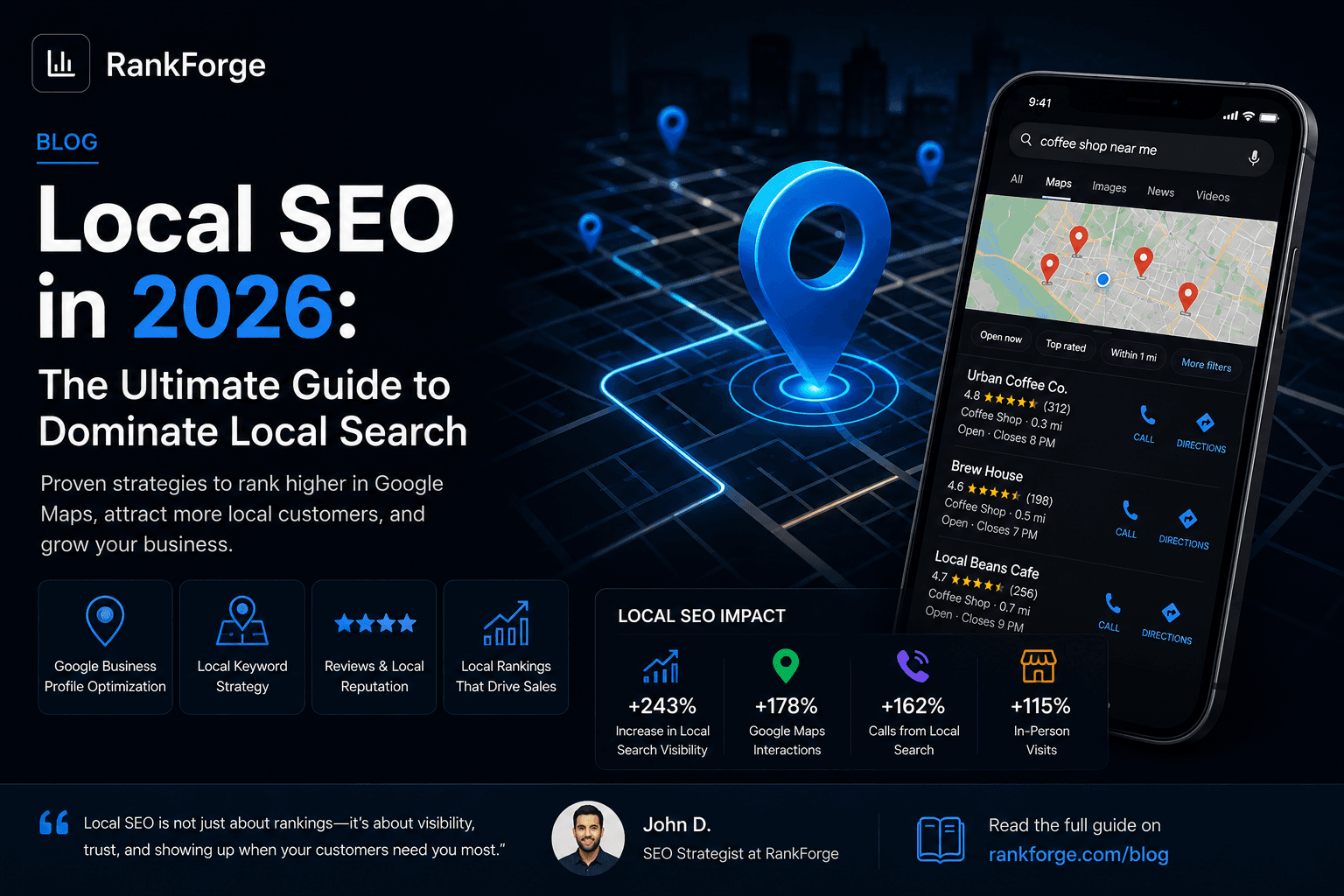
Why Local SEO Matters for Service Businesses
Local SEO is the system that helps nearby customers discover, evaluate, and contact a business when they are ready to act. For service businesses, it is often the difference between being compared and being invisible. A homeowner searching for urgent HVAC repair, a patient comparing dental clinics, or a founder looking for a local consultant is not browsing casually. They need a clear answer, a trustworthy business, and a fast path to call, book, or request a quote.
The strongest local SEO programs combine Google Business Profile optimization, technically sound pages, accurate citations, helpful local content, reviews, structured data, and clean measurement. That is why a serious local strategy should connect Local SEO Services, Technical SEO Services, Website Development, and analytics instead of treating each item as a separate checklist.
RankForge Insight: Local SEO is not about adding city names to weak pages. It is about proving that your business is relevant, nearby, credible, and useful for a specific local need.
How to Rank Higher in Google Maps & Local Search
Local SEO is the process of improving visibility for searches with local intent across Google Search, Google Maps, AI-assisted results, and other discovery platforms. It includes your Google Business Profile, your website, your reviews, your local citations, your service pages, and the wider proof that your business is real and trusted in its market.
A local search can be explicit, such as "plumber in Multan" or "SEO agency near me." It can also be implicit, such as "emergency roof repair" or "best dentist open Saturday." In both cases, Google may localize results based on the searcher's location, query, device, and available business data.
Local SEO is broader than the map pack. The map pack matters, but buyers also click organic results, read reviews, compare websites, scan pricing, look at case studies, and ask AI tools for recommendations. A business that only optimizes its profile but ignores its website is leaving trust unfinished. A business that only writes pages but ignores reviews and profile accuracy is also incomplete.
For service businesses, local SEO is also an operations mirror. If phones are not answered, hours are wrong, reviews go unanswered, or service pages promise work the team does not actually provide, search visibility will not fix the underlying customer experience. The best local programs connect marketing, sales, service delivery, and reporting so the business can improve the full path from search to booked work.
| Local SEO asset | What it supports | Example improvement |
|---|---|---|
| Google Business Profile | Map visibility and calls | Categories, services, photos, reviews |
| Service pages | Organic rankings and conversion | Dedicated pages for high-value services |
| Location pages | City and neighborhood relevance | Unique proof, FAQs, service coverage |
| Reviews | Trust and prominence | Ethical review requests and responses |
| Citations | Business identity consistency | Accurate name, address, phone, URL |
| Schema | Entity clarity | LocalBusiness, Service, FAQ, Breadcrumb |
| Analytics | Decision quality | Calls, forms, bookings, revenue tracking |
Best Practice: Think of local SEO as a customer decision system. Every profile field, page section, review, link, and conversion path should help a nearby buyer choose with confidence.
score = (business_value * ranking_gap) / implementation_effortWhy Local SEO Matters in 2026
Local search continues to be valuable because it is close to action. Google's Think with Google research on mobile search connecting consumers to stores reported that 76% of people who search on smartphones for something nearby visit a business within a day, and 28% of those searches result in a purchase. That is why local visibility can influence real calls, visits, appointments, and booked jobs.
Reviews also shape decisions. BrightLocal's Local Consumer Review Survey 2025 found that 74% of consumers use two or more websites when checking business reviews, 42% trust reviews as much as personal recommendations, and 96% are open to writing a review. These are useful statistics because they show that local trust is not built on Google alone.
In 2026, local SEO also intersects with AI search. AI Overviews, answer engines, and large language model recommendations rely on clear entity signals, consistent business information, helpful content, and credible third-party references. If your business details are inconsistent, your pages are thin, or your reviews tell a weak story, AI-assisted discovery has less confidence in your brand.
This is why local SEO should be treated as an owned growth channel. Ads can produce immediate visibility, referrals can produce warm opportunities, and social media can support awareness. Local SEO compounds because the same assets keep working: optimized profiles, stronger pages, useful resources, review history, and trusted citations. When those assets are maintained, every future campaign has a better foundation.
Pro Tip: Use Google Ads Management to test urgent, high-value local services while organic local SEO matures. Paid search can reveal which queries convert, and that data can guide permanent service pages.
Local SEO matters most when it is tied to business priorities. Ranking for a popular service that produces low-margin leads may not help. Ranking for a lower-volume, high-intent service can be worth much more. Start with profitable services, then build the local visibility system around those services.
How Google Ranks Local Businesses
Google's official local ranking guidance describes three core factors: relevance, distance, and prominence. Relevance is how well your business matches the search. Distance is how far the business is from the searcher or searched location. Prominence is how well-known and trusted the business appears online.
You cannot fully control distance, but you can strengthen relevance and prominence. Relevance improves when your categories, services, website pages, content, schema, and internal links clearly describe what you do. Prominence improves through reviews, links, local mentions, citations, brand searches, photos, and consistent activity.
| Ranking factor | What it means | What you can improve |
|---|---|---|
| Relevance | Match between search and business | Categories, services, page content, schema |
| Distance | Proximity to searcher or searched area | Accurate address and service areas |
| Prominence | Trust, reputation, and authority | Reviews, links, citations, brand proof |
Common Mistake: Trying to rank everywhere with one generic page. Google needs clear service and location signals, and users need pages that answer their actual local questions.
Local rankings also vary by query type. A search for "coffee shop near me" may be heavily proximity-driven. A search for "best commercial roofing contractor in city" may rely more on reviews, website depth, authority, and proof. This is why local SEO should begin with SERP analysis, not assumptions.
For strategic planning, review live search results, map competitors, directory presence, local packs, ads, AI summaries, and organic pages. Then decide whether each target needs a profile improvement, a service page, a location page, a technical fix, a review push, a citation cleanup, or a broader SEO Consulting roadmap.
Google Business Profile Optimization
Your Google Business Profile is often the first local asset a customer sees. It should be accurate, complete, and maintained. Google's Business Profile Help explains that verified profiles can manage business hours, website, phone, location, photos, videos, and reviews across Search and Maps.
The profile should reflect the real-world business. Do not add keywords to the business name unless they are part of the legal or public-facing name. Do not create fake locations. Do not use categories that describe services you do not truly provide. Shortcuts can create suspension risk and reduce trust.
Profile optimization should also account for conversion quality. A service business may receive more calls after improving visibility, but not every call is valuable. Track which categories, services, posts, and landing pages attract the right inquiries. If the profile produces price shoppers for low-margin work while better services remain hidden, the profile needs sharper positioning, not just more activity.
Google Business Profile checklist:
- Verify profile ownership
- Choose the most accurate primary category
- Add relevant secondary categories
- Confirm phone, website, address, and service areas
- Add complete services and descriptions
- Update regular and holiday hours
- Add real photos and videos
- Use a booking or contact link where relevant
- Answer Q&A accurately
- Respond to reviews consistently
- Track profile links with UTM parameters where appropriate
Best Practice: Treat your profile like a conversion asset, not a directory listing. A complete profile should answer who you help, what you do, where you operate, when you are available, and why people trust you.
Website Optimization for Local SEO
The website confirms what the profile introduces. A user may find you in the map pack, but the website often decides whether they call. Strong local websites are fast, clear, crawlable, mobile-friendly, and built around real service intent.
Use Google Search Central fundamentals: descriptive titles, accessible pages, useful content, clean internal links, and crawlable structure. Then add local layers: location relevance, service detail, proof, FAQs, reviews, contact options, and structured data.
Performance matters because local users are often on mobile. PageSpeed Insights can identify performance issues, while web.dev Core Web Vitals guidance defines good thresholds as Largest Contentful Paint at 2.5 seconds or less, Interaction to Next Paint at 200 milliseconds or less, and Cumulative Layout Shift at 0.1 or less at the 75th percentile.
Pro Tip: On a local service page, make the first screen useful. Show the service, location relevance, trust proof, and primary action before users have to hunt.
Website checklist:
- Clear service and location page architecture
- Fast mobile performance
- Clickable phone numbers
- Short forms with clear expectations
- Helpful FAQs
- Internal links to related services
- Real proof from reviews or Case Studies
- LocalBusiness or Service schema where appropriate
- Tracking for calls, forms, and booking clicks
If your current site is hard to update or slow on mobile, Website Development may be part of the local SEO solution.
Service Pages vs Location Pages
Service pages and location pages solve different problems. A service page explains what you do. A location page explains where you do it and why your business is relevant in that area. Both can rank, but they should not be duplicates.
| Page type | Best for | Must include |
|---|---|---|
| Service page | High-value service intent | Process, benefits, FAQs, proof, CTA |
| Location page | City or neighborhood intent | Local context, service area, reviews, directions |
| Service-location page | Competitive markets | Unique local proof and specific service details |
| Resource page | Research intent | Helpful education and internal links |
Common Mistake: Creating dozens of thin city pages with only the city name changed. These pages rarely build trust and can make the site feel generic.
A strong location page should include unique details: service availability, local customer problems, area-specific FAQs, photos, reviews from that market, nearby landmarks if useful, and links to relevant service pages. A strong service page should explain the service deeply enough that a buyer knows what happens next.
When building pages, connect them naturally. A Local SEO page can link to Technical SEO Services for crawl and indexing issues, Pricing for engagement options, and Contact for market-specific questions. These links help users and search engines understand the journey.
Local Content Strategy
Local content should answer real questions from local buyers. It should not exist only to target keywords. The best topics come from sales calls, reviews, Google Business Profile Q&A, Search Console data, competitor gaps, seasonal demand, and objections heard by the team.
Examples of useful local content:
- Cost guides for important services
- Emergency service explainers
- Neighborhood or city service guides
- Seasonal maintenance checklists
- Comparison pages
- Local case studies
- FAQ pages based on sales questions
- Resource downloads and checklists
Local content should also support internal teams. Sales teams can use cost guides to answer pricing questions. Customer service teams can send maintenance checklists before appointments. Leadership can use local case studies to explain why certain markets deserve investment. When content helps real conversations, it tends to become more specific, more credible, and more useful for search.
RankForge Insight: Local content performs best when it reduces buying friction. If a page helps a customer understand cost, timing, process, risk, or next steps, it is more likely to support revenue.
Use Google Search Console to find queries with impressions but low clicks. Those queries often reveal page title issues, missing sections, or unclear intent. Use Resources to support educational content that users can return to or share with decision-makers.
Entity SEO
Entity SEO helps search systems understand the business as a real-world thing: its name, services, locations, people, categories, relationships, and proof. For local SEO, entity clarity is especially important because local results depend on confidence.
Structured data supports this clarity. Google's LocalBusiness structured data documentation explains how business details such as address, phone, hours, geo coordinates, departments, and URLs can be marked up. The vocabulary is defined by Schema.org.
Practical entity signals include:
- Consistent business name
- Correct phone and address
- Clear service categories
- Staff or leadership information
- Organization and LocalBusiness schema
- SameAs social profile references
- Local citations and memberships
- Branded search demand
- Reviews mentioning services and locations
Best Practice: Schema should match visible page content. Do not mark up services, locations, reviews, or business details that users cannot verify on the page.
AI Search & Local SEO
AI search does not remove local SEO fundamentals. It raises the value of clarity. AI systems summarize businesses using information from search results, websites, profiles, reviews, directories, and trusted references. If those sources are inconsistent, the business may be misunderstood or ignored.
For local businesses, AI readiness means clear service pages, strong entity signals, consistent citations, descriptive reviews, helpful FAQs, and content that directly answers buyer questions. This overlaps with Answer Engine Optimization, Generative Engine Optimization, and semantic SEO, but the practical work is familiar: be specific, accurate, helpful, and verifiable.
AI search checklist:
- Use clear service and location language
- Answer common buying questions
- Add structured data
- Keep GBP and citations consistent
- Publish trustworthy local resources
- Include proof where claims are made
- Maintain review velocity and responses
- Avoid vague marketing copy
Pro Tip: Write for the customer first, then make the page easy for machines to understand. Natural clarity is better than forced terminology.
Reviews & Reputation Management
Reviews influence trust, clicks, calls, and local prominence. A business with steady, specific, recent reviews often feels safer than a business with a stale profile, even if the stale profile has more total reviews.
BrightLocal's 2025 survey found that 74% of consumers use two or more websites when checking reviews and 96% are open to writing reviews. This supports a simple lesson: ask consistently, respond professionally, and monitor more than one platform.
Review process checklist:
- Ask after a successful customer interaction
- Make the request simple
- Never offer incentives for positive reviews
- Respond to positive reviews with appreciation
- Respond to negative reviews calmly
- Look for repeated service themes
- Use review insights in FAQs and service pages
Common Mistake: Copying review text into pages without context. It is better to summarize themes, show selected proof responsibly, and link users to real review platforms when appropriate.
Local Citations
Citations are mentions of your business name, address, phone number, and website across the web. They help reinforce business identity, especially when they appear on trusted directories, industry platforms, local organizations, and mapping services.
Citation work is not glamorous, but it is important after changes. Rebrands, phone number updates, office moves, acquisitions, and franchise expansions can create inconsistent data. Inconsistency can confuse users and reduce trust.
Citation cleanup checklist:
- Confirm official business name
- Confirm address or service area
- Confirm primary phone number
- Confirm website URL
- Update old brand mentions
- Remove duplicates where possible
- Fix wrong categories
- Add photos and hours where supported
- Record login ownership
Best Practice: Prioritize quality and accuracy over volume. A few authoritative, accurate citations are more useful than hundreds of weak directory submissions.
Local Link Building
Local links help show that a business is part of a real community or industry. Good local links often come from partnerships, sponsorships, local news, chambers of commerce, professional associations, charities, suppliers, schools, events, and useful resources.
Link building should not feel artificial. If the business does something worth mentioning, document it and make it easy for others to reference. If the business has expertise, publish helpful resources. If it serves a niche, contribute genuinely to that niche.
Local link ideas:
- Sponsor a local event
- Join a chamber or association
- Publish a city-specific resource
- Partner with complementary businesses
- Share original local data
- Create helpful checklists
- Earn coverage for community work
- Publish detailed Case Studies
RankForge Insight: Local links work best when they are tied to real relationships. The goal is not only authority; it is evidence that the business belongs in the market.
Measuring Local SEO Success
Local SEO reporting should connect visibility to business outcomes. Rankings matter, but they are not enough. Track map pack visibility, organic clicks, calls, forms, direction requests, bookings, reviews, and lead quality.
Reporting should also separate what changed from what happened. If calls increased after a new location page launched, that is useful. If rankings improved after citation cleanup and review responses, note it. If traffic increased but leads did not, investigate intent, page speed, CTA clarity, and form friction. Local SEO improves faster when every report produces a decision.
Google Analytics can mark important actions as key events, such as form submissions, phone clicks, booking clicks, and resource downloads. Search Console can show query and page performance. GBP performance can show profile interactions.
| Metric | What it tells you | Better question |
|---|---|---|
| Rankings | Visibility direction | Are we ranking for profitable services? |
| Impressions | Search exposure | Are impressions coming from the right market? |
| Clicks | Interest | Which pages earn qualified traffic? |
| Calls | Action | Are calls relevant and bookable? |
| Forms | Demand | Which services drive inquiries? |
| Reviews | Trust health | Are reviews recent, specific, and answered? |
| Revenue | Business impact | Which SEO work creates customers? |
Best Practice: Separate branded and non-branded demand. Branded growth shows awareness. Non-branded local growth shows discovery.
Common Local SEO Mistakes
Most local SEO problems are not mysterious. They come from incomplete profiles, thin pages, weak tracking, poor mobile experience, inconsistent data, and no review process.
Common mistakes include:
- Using the wrong GBP primary category
- Adding keywords to the business name
- Ignoring duplicate listings
- Creating thin city pages
- Sending all links to the homepage
- Forgetting phone click tracking
- Ignoring mobile page speed
- Publishing generic AI content
- Asking for reviews inconsistently
- Not responding to reviews
- Treating SEO and paid search as separate worlds
Common Mistake: Reporting "traffic is up" without checking lead quality. More traffic is not automatically better if it brings poor-fit inquiries.
If a business has limited budget, focus first on profile accuracy, high-value service pages, conversion tracking, and reviews. Then expand into content, links, resources, and broader authority.
Local SEO Checklist
Use this checklist as a practical starting point:
- Verify Google Business Profile ownership
- Confirm categories, phone, hours, website, and service area
- Add complete services and descriptions
- Upload real photos and videos
- Build or improve priority service pages
- Create unique location pages where justified
- Add internal links between services, resources, pricing, and contact pages
- Improve mobile speed with PageSpeed Insights
- Add LocalBusiness, Service, Breadcrumb, and FAQ schema where appropriate
- Clean up core citations
- Build an ethical review request process
- Respond to reviews
- Track calls, forms, bookings, and key events
- Review Search Console queries monthly
- Use Pricing and Contact pages to reduce friction for serious buyers
Pro Tip: Keep a change log. Local SEO improves through many small actions, and a log helps connect profile updates, content changes, technical fixes, and ranking movement.
Frequently Asked Questions
What is local SEO?
Local SEO improves visibility for searches with local intent on Google Search, Google Maps, and related discovery platforms.
How long does local SEO take?
Some profile and technical fixes can help within weeks, but competitive markets usually need three to six months of consistent work.
Is Google Business Profile enough?
No. It is important, but your website, reviews, citations, links, and tracking also matter.
Should I create city pages?
Create city pages only when they are useful and unique. Avoid thin pages that simply swap city names.
Do reviews affect local SEO?
Yes. Reviews support trust and can influence prominence, especially when they are recent, specific, and consistently answered.
Do I need schema for local SEO?
Schema is not a magic ranking switch, but it helps search engines understand your business, services, locations, and page structure.
What should I track?
Track calls, forms, bookings, direction requests, GBP actions, organic clicks, rankings, reviews, and revenue quality.
Can Google Ads help local SEO?
Ads do not directly improve organic rankings, but they can generate immediate leads and reveal which services deserve stronger organic pages.
How often should I update my profile?
Review it monthly, update hours whenever they change, add photos regularly, and respond to reviews as they arrive.
What is the biggest local SEO mistake?
The biggest mistake is treating local SEO as a one-time setup instead of an ongoing trust and visibility system.
Should small businesses invest in local SEO?
Yes, if local customers search before calling, booking, visiting, or comparing providers.
Where should I start?
Start with profile accuracy, priority service pages, review process, tracking, and mobile performance. Then expand into content and authority.
Conclusion
Local SEO in 2026 is not a shortcut or a single profile update. It is the discipline of making a local business easy to find, easy to understand, and easy to trust. The work includes Google Business Profile optimization, technical SEO, service pages, location pages, reviews, citations, local links, schema, AI search readiness, and measurement.
The best strategy starts with business priorities. Identify profitable services, map them to real locations, build pages that answer local intent, strengthen the profile, earn reviews ethically, and track actions that matter. Use Resources to educate buyers, Case Studies to show proof, Pricing to clarify engagement options, and Contact when a custom local roadmap is needed.
RankForge approaches local SEO as a long-term growth system rather than a collection of disconnected tasks. The aim is simple: help the right nearby customers find the business, trust it faster, and take the next step with confidence.
Ready to turn this into a roadmap?
RankForge can audit your site, prioritize the best opportunities, and build the growth system behind them.
Request free audit