Google Ads Audit Guide to Reduce Wasted Spend
Discover how to identify wasted Google Ads spend, improve campaign performance, optimize landing pages, and increase ROI with practical audit techniques.
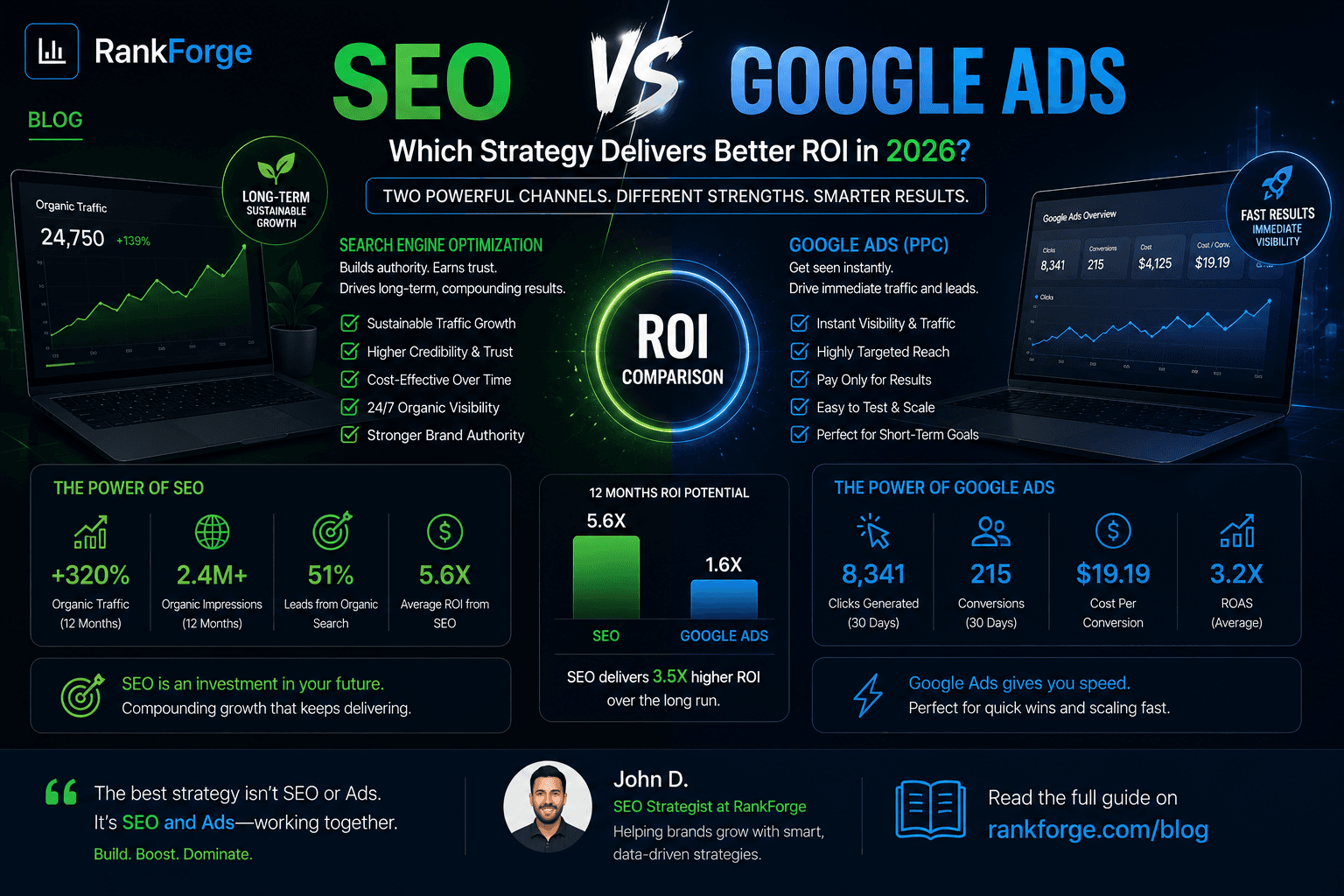
Common Causes of Wasted Google Ads Budget
Wasted Google Ads spend is any paid search budget that does not move the business closer to a valuable outcome. It can be obvious, such as irrelevant clicks from poor broad match targeting. It can also be hidden, such as campaigns that generate cheap form fills from unqualified leads, phone calls from the wrong location, or conversions that are counted twice because tracking is broken.
In simple terms: wasted Google Ads spend is money spent on clicks, impressions, audiences, keywords, or landing pages that do not create qualified demand, pipeline, revenue, or useful learning.
Answer block: A Google Ads audit should look for waste in search terms, match types, negative keywords, landing pages, conversion tracking, Quality Score diagnostics, bidding targets, device performance, location performance, and budget allocation.
Paid search waste usually appears in three places: traffic quality, conversion quality, and business quality. Traffic quality asks whether the right people clicked. Conversion quality asks whether the action was real and meaningful. Business quality asks whether the lead, sale, or booking was profitable enough to justify the cost.
That is why serious Google Ads Management should not be judged only by click-through rate or cost per click. Those metrics can be useful, but they do not prove that the account is efficient. A campaign can have a low CPC and still waste budget if the search intent is wrong. A campaign can have a high CPC and still be profitable if it brings qualified customers with strong lifetime value.
The goal of a PPC audit is not to cut spend blindly. The goal is to move budget away from low-value demand and toward searches, audiences, pages, and offers that can produce measurable business outcomes.
How to Improve Google Ads Performance & ROI
Businesses waste PPC budget when the account structure, tracking, and landing page experience drift away from business reality. The most common pattern is simple: campaigns are launched with reasonable assumptions, but nobody keeps refining them as search terms, competitors, costs, offers, and customer behavior change.
Waste also happens when teams optimize for the wrong metric. If the goal is leads, Google Ads may drive more leads. But if the conversion action includes spam forms, job seekers, vendor inquiries, accidental calls, or unqualified traffic, the system may learn from weak signals. That can increase volume while lowering lead quality.
| Waste source | What it looks like | Better question |
|---|---|---|
| Broad targeting | Many clicks, weak intent | Are search terms commercially relevant? |
| Weak tracking | Conversions look high | Are conversions real and valuable? |
| Bad landing pages | Clicks do not convert | Does the page match the query and offer? |
| Poor budget allocation | Spend goes to low-margin services | Which campaigns create profitable outcomes? |
| No feedback loop | Leads increase but sales do not | Which leads become customers? |
RankForge Insight: PPC optimization is not only media buying. It is the connection between search intent, offer clarity, landing page quality, conversion tracking, and sales feedback.
For companies that depend on both paid and organic demand, PPC data should also inform SEO, On-Page SEO, and Content Writing. Search terms that repeatedly convert can become service pages, comparison content, FAQs, or resource guides. Queries that waste paid budget can reveal what your organic pages should avoid targeting.
score = (business_value * ranking_gap) / implementation_effortCommon Google Ads Mistakes
Most wasted Google Ads spend comes from a few recurring mistakes. They are not always dramatic. Many accounts lose money through small leaks that compound every day.
Common Google Ads mistakes include:
- Running broad match without enough conversion quality data
- Ignoring the Search Terms Report
- Forgetting negative keyword maintenance
- Sending all clicks to the homepage
- Counting weak actions as primary conversions
- Treating every lead as equal
- Mixing high-intent and low-intent keywords in one ad group
- Using the same landing page for every service
- Letting mobile, desktop, and tablet performance blend together
- Spreading small budgets across too many campaigns
- Optimizing CPA without checking close rate or revenue
- Changing bidding targets too often
Common Mistake: Reducing Google Ads cost by pausing campaigns without understanding why spend is inefficient. Cutting budget can hide the problem instead of fixing match quality, landing page relevance, or conversion tracking.
A useful audit separates symptoms from causes. High CPA may be caused by expensive clicks, poor conversion rate, irrelevant search terms, weak landing pages, slow response time, or low close rate. Each cause requires a different fix.
Broad Match Problems
Broad match can be useful, but it is also one of the easiest ways to waste PPC budget. Google's keyword match type documentation explains that broad match can show ads on searches related to a keyword, including searches that may not contain the direct keyword meaning. This gives the system more reach, but reach without guardrails can produce irrelevant traffic.
Broad match works best when four conditions are in place: clean conversion tracking, enough conversion volume, strong negative keyword controls, and landing pages that clearly define the offer. Without those controls, broad match may spend on research queries, low-intent variations, job searches, free-seeking searches, competitor confusion, or services the business does not provide.
| Match type | Strength | Waste risk |
|---|---|---|
| Broad match | Finds more query variations | Can drift into weak intent |
| Phrase match | Balances reach and control | Can still match loose variations |
| Exact match | Strongest steering | Can miss useful related demand |
| Negative match | Blocks unwanted traffic | Needs ongoing maintenance |
Pro Tip: Do not judge broad match by clicks alone. Judge it by search term quality, conversion quality, CPA, ROAS, and downstream sales outcomes.
Broad match is not automatically bad. The mistake is using it before the account has enough truth. If conversion tracking is weak, broad match may optimize toward false positives. If landing pages are vague, it may match vague searches. If negative keywords are not maintained, it may keep buying the same irrelevant intent.
Negative Keywords
Negative keywords prevent ads from showing for unwanted searches. Google Ads Help defines a negative keyword as a keyword that stops an ad from being triggered by a certain word or phrase. In PPC optimization, negative keywords are one of the fastest ways to reduce Google Ads cost without reducing qualified demand.
Negative keyword work should be strategic. Do not block words just because one query performed poorly. Look for repeated patterns that clearly signal poor fit.
Common negative keyword categories:
- Free, cheap, DIY, template, sample
- Jobs, salary, hiring, career
- Training, course, certification
- Used, second-hand, parts, manual
- Competitor names when conquesting is not intentional
- Locations outside the service area
- Services the business does not offer
Best Practice: Maintain shared negative keyword lists for account-wide exclusions, then use campaign-level negatives for service-specific filtering.
Negative keywords should be reviewed with sales feedback. A query that looks poor in Google Ads may sometimes produce high-value calls. A query that looks strong may produce unqualified leads. The Search Terms Report tells you what people typed; your CRM or intake notes tell you whether those people were worth paying for.
Search Intent
Search intent is the reason behind the query. Paid search optimization fails when campaigns treat every keyword as if the user is equally ready to buy. A person searching "what is PPC" is not the same as someone searching "Google Ads agency for SaaS demo requests." The first query is educational. The second is commercial.
| Intent type | Example query | Best response |
|---|---|---|
| Informational | how does Google Ads work | Educational content or resource |
| Comparison | Google Ads vs SEO | Comparison page or consultation CTA |
| Commercial | Google Ads management pricing | Service page and proof |
| Transactional | hire Google Ads consultant | Direct landing page |
| Support | fix conversion tracking | Audit or technical support page |
For organic channels, informational intent may be useful for Resources or Content Writing. For paid search, informational intent should be handled carefully unless the campaign has a remarketing, lead nurturing, or high-value education strategy.
RankForge Insight: The best paid search accounts do not buy keywords. They buy moments of intent.
Intent should influence ad copy, landing page, offer, and bid strategy. High-intent keywords can support direct CTAs. Research-heavy terms may need a softer resource, calculator, checklist, or comparison guide.
Landing Page Optimization
Landing pages are where paid traffic becomes business value or wasted spend. A strong campaign can underperform if the page is slow, vague, generic, or disconnected from the query. Google includes landing page experience as one of the components in its Quality Score documentation, alongside expected click-through rate and ad relevance.
A high-performing paid search landing page should:
- Match the searcher's intent
- Repeat the offer clearly
- Explain who the service is for
- Show proof or credibility
- Remove unnecessary distractions
- Load quickly on mobile
- Use a simple form or clear call button
- Answer common objections
- Track every important action
Common Mistake: Sending all paid traffic to the homepage. A homepage introduces the company; a landing page should continue the exact conversation started by the query and ad.
Landing page optimization often overlaps with Technical SEO and Website Development. Speed, accessibility, form reliability, crawlable content, and mobile usability affect more than organic rankings. They also affect paid conversion rate, cost efficiency, and lead quality.
If the landing page does not explain the offer better than the ad, the click was not given enough help to convert.
Conversion Tracking
Conversion tracking is where many Google Ads audits find the largest hidden waste. If the account is measuring the wrong actions, every automated decision becomes less reliable. Google Ads Help explains that website conversion measurement helps analyze actions users take after interacting with ads, which is essential for campaign optimization.
Good conversion tracking distinguishes between primary and secondary actions. A qualified form submission may be primary. A page view, scroll, or button hover should not be primary. Phone calls may be valuable, but only if call duration, source, and lead quality are reviewed.
Tracking audit checklist:
- Primary conversions represent real business value
- Duplicate conversions are removed
- Thank-you page visits are not inflated
- Forms fire only after successful submission
- Phone clicks and calls are tracked separately
- Offline sales feedback is imported where possible
- Conversion values reflect real economics
- GA4 and Google Ads numbers are understood, not blindly forced to match
Google Tag Manager can deploy Google Ads conversion tags and reduce duplicate conversion issues when configured carefully. Google Analytics can also help define key events that support deeper reporting.
Best Practice: Before changing bids, verify tracking. Optimization built on broken conversion data can scale waste faster.
Quality Score
Quality Score is a diagnostic tool, not the final goal. Google's Quality Score documentation describes it as a 1-10 keyword-level diagnostic based on expected CTR, ad relevance, and landing page experience. Google's ad quality guidance also notes that higher ad quality can support better performance, including better positions and lower cost.
| Quality Score component | What it signals | Practical fix |
|---|---|---|
| Expected CTR | Searchers may not be attracted to the ad | Improve offer, specificity, assets |
| Ad relevance | Ad may not match query intent | Tighten ad groups and copy |
| Landing page experience | Page may not satisfy the click | Improve page speed, relevance, trust |
Pro Tip: Do not optimize for the number alone. Use Quality Score components to diagnose where the user experience is weak.
Quality Score problems often reveal structural issues. If one ad group contains too many unrelated keywords, ad relevance suffers. If the landing page is generic, landing page experience suffers. If the offer is unclear, expected CTR may lag. Fixing those issues can improve both paid search performance and broader conversion strategy.
Search Terms Report
The Search Terms Report is one of the most important tools for finding wasted Google Ads spend. Google Ads Help says the Search Terms Report shows how ads performed when triggered by actual searches. It can reveal irrelevant queries, new keyword opportunities, negative keyword patterns, landing page gaps, and content ideas.
Review the report weekly in active accounts. Look for:
- Spend without conversions
- Conversions from poor-fit searches
- High-cost queries with weak intent
- New exact-match keyword opportunities
- Repeated negative keyword themes
- Queries that deserve dedicated landing pages
- Search terms that suggest organic content opportunities
RankForge Insight: The Search Terms Report is not just a PPC tool. It is market research. It shows the language buyers use when money is on the line.
Search term insights can also support On-Page SEO, Local SEO, and SEO. If paid search repeatedly finds profitable language, organic content can help capture that demand without paying for every click forever.
PPC Audit Checklist
A PPC audit should move from tracking truth to traffic quality, then to landing pages and budget decisions. Auditing in the wrong order can waste time. For example, CPA analysis is unreliable if conversion tracking is broken.
Use this PPC audit checklist:
- Confirm business goals and profit model.
- Verify primary and secondary conversion actions.
- Check Google Ads tag, GA4, and Tag Manager setup.
- Review campaign structure by service, location, and intent.
- Analyze Search Terms Report waste.
- Add or refine negative keyword lists.
- Review match type strategy.
- Compare CPA, ROAS, conversion rate, and close rate.
- Audit landing page speed, message match, and forms.
- Review Quality Score diagnostics.
- Segment performance by device, location, time, and audience.
- Reallocate budget toward profitable campaigns.
- Document changes and monitor learning periods.
Best Practice: A Google Ads audit should end with a prioritized action plan, not a long export. Every recommendation should explain expected impact, confidence, and implementation effort.
For businesses comparing channel investment, Pricing and Case Studies pages can help leadership understand whether the next step should be paid search cleanup, landing page improvement, or a broader search strategy.
CPA Optimization
CPA optimization means reducing the cost required to generate a qualified action. The key word is qualified. Reducing CPA by attracting worse leads is not an improvement. Google Ads Target CPA bidding can help optimize for conversions at a desired average cost per action, but it depends on accurate conversion data.
Ways to reduce CPA:
- Remove irrelevant search terms
- Add negative keywords
- Improve landing page conversion rate
- Separate high-intent and low-intent campaigns
- Pause poor-fit geographies
- Improve ad relevance
- Tighten offers and forms
- Import offline conversion quality
- Adjust budgets toward campaigns with stronger close rates
Common Mistake: Setting a target CPA too low before the campaign has enough conversion data. The system may reduce volume or chase low-quality opportunities.
CPA should be judged against margin and close rate. A $120 CPA may be excellent for a high-ticket service. A $30 CPA may be terrible if leads rarely buy.
ROAS Optimization
ROAS optimization focuses on revenue or conversion value instead of lead volume. Google Ads Target ROAS bidding uses conversion values to help maximize return on ad spend. This is useful when different conversions have different values.
ROAS tracking requires better data discipline. Ecommerce brands may pass transaction values directly. Lead generation businesses need estimated values, CRM imports, or offline conversion feedback. Without value data, the account may treat every lead as equal.
| Optimization goal | Use when | Watch out for |
|---|---|---|
| Lower CPA | Leads have similar value | Can attract low-quality leads |
| Higher ROAS | Revenue values vary | Needs reliable value tracking |
| Higher conversion rate | Landing page is weak | May ignore lead quality |
| Higher lead quality | Sales feedback is available | Needs CRM discipline |
Pro Tip: If the sales team knows which leads are valuable but Google Ads does not, the account is optimizing with incomplete information.
Conversion Rate Optimization
Conversion rate optimization turns more of the right clicks into meaningful actions. It does not mean making forms aggressive or adding pressure everywhere. It means reducing confusion and increasing confidence.
Paid search CRO improvements include:
- Clear headline matching the query
- Strong above-the-fold value proposition
- Specific proof points
- Short forms for high-intent traffic
- Detailed forms for qualification when needed
- Fast mobile loading
- Clear phone and calendar options
- Objection-handling FAQs
- Consistent message from keyword to ad to page
For content-heavy offers, Content Writing can improve clarity and trust. For technical friction, Website Development can improve speed, forms, and mobile usability. For positioning gaps, SEO and paid search teams should share insights rather than operate separately.
Best Practice: Test one meaningful change at a time when traffic volume allows. If volume is low, prioritize obvious friction fixes instead of running underpowered experiments.
Budget Allocation
Budget allocation decides whether the best parts of the account have enough room to work. Many accounts waste spend by giving equal budget to unequal opportunities. A campaign for a low-margin service should not receive the same treatment as a campaign for a high-margin, high-close-rate offer.
Budget review checklist:
- Which campaigns spend fastest?
- Which campaigns produce qualified leads?
- Which campaigns produce revenue?
- Which locations convert profitably?
- Which devices waste spend?
- Which times or days perform best?
- Which campaigns are limited by budget but profitable?
- Which campaigns consume budget without strategic value?
RankForge Insight: Budget should follow profitable intent, not internal politics. If one service line produces better customers, the account should reflect that reality.
Sometimes the right answer is not more spend. It may be better tracking, stronger landing pages, tighter negatives, or a focused Contact path for high-intent users.
Real-world Examples
Example 1: A home services account had strong click volume but weak booked jobs. The Search Terms Report showed broad match spending on DIY and parts-related searches. The fix was a negative keyword list, tighter ad groups, and service-specific landing pages. Spend decreased slightly, but qualified calls improved.
Example 2: A B2B campaign had a low CPA but poor sales quality. The form counted every download as a primary conversion. After separating resource downloads from demo requests and importing qualified lead data, bidding shifted toward fewer but better conversions.
Example 3: A local clinic sent all paid traffic to the homepage. Users had to search for insurance details, service pages, and appointment options. A focused landing page tied to the main service improved conversion rate and made PPC reporting easier. The same insights later informed Local SEO pages.
Example 4: An ecommerce campaign optimized for purchases but passed no conversion value. All sales looked equal. After value tracking was fixed, budget moved toward products with stronger margin and higher average order value.
Pro Tip: Real PPC optimization often comes from connecting media data with business reality. Ads platforms show what happened online; sales and revenue data explain whether it mattered.
Final Action Plan
To reduce wasted Google Ads spend, start with the truth layer: tracking, conversion quality, and business goals. Then move into traffic quality, landing pages, bidding, and budget allocation. Do not make random changes every day. Work from diagnosis to prioritization to implementation.
Final action plan:
- Define what a valuable conversion means.
- Verify conversion tracking in Google Ads, GA4, and Tag Manager.
- Review the Search Terms Report for wasted spend.
- Add negative keywords based on repeated poor-fit intent.
- Separate campaigns by service, location, and buying intent.
- Improve landing pages for message match and conversion rate.
- Use Quality Score diagnostics to identify relevance issues.
- Optimize CPA only after lead quality is understood.
- Optimize ROAS only when value tracking is reliable.
- Reallocate budget toward profitable demand.
- Review performance weekly and strategy monthly.
For teams that want a deeper paid search review, RankForge can connect Google Ads data with landing pages, analytics, SEO opportunities, and business goals. Start with Google Ads, review helpful Resources, compare options on Pricing, or Contact the team with questions about your account.
Frequently Asked Questions
What is wasted Google Ads spend?
Wasted Google Ads spend is budget spent on clicks, queries, audiences, or conversions that do not create qualified demand, revenue, or useful learning.
How do I find wasted spend in Google Ads?
Start with conversion tracking, then review the Search Terms Report, negative keywords, match types, landing page performance, Quality Score diagnostics, CPA, ROAS, devices, locations, and budget allocation.
What is a Google Ads audit?
A Google Ads audit is a structured review of tracking, campaigns, keywords, search terms, ads, landing pages, bidding, budgets, and business outcomes.
How often should I review the Search Terms Report?
Active accounts should review it weekly. Smaller accounts may review it biweekly, but high-spend campaigns need more frequent checks.
Are broad match keywords bad?
No. Broad match can work well with strong tracking, Smart Bidding, negative keywords, and enough conversion data. It becomes risky when those controls are missing.
How do negative keywords reduce wasted spend?
Negative keywords prevent ads from showing for irrelevant searches, which helps budget focus on better intent.
Why is my CPA high?
CPA can be high because of irrelevant search terms, expensive auctions, weak landing pages, poor ad relevance, low conversion rate, or unqualified conversion tracking.
How can I reduce CPA without hurting lead quality?
Improve search term quality, landing page relevance, conversion tracking, and sales feedback before lowering bids aggressively.
What is ROAS in Google Ads?
ROAS stands for return on ad spend. It compares conversion value or revenue against advertising cost.
Why does conversion tracking cause wasted spend?
If Google Ads optimizes toward weak, duplicate, or false conversions, it may spend more on traffic that looks successful but does not create business value.
Does Quality Score lower cost?
Quality Score is diagnostic, but better ad quality can support better performance. Use it to find issues with expected CTR, ad relevance, and landing page experience.
Should I pause keywords with no conversions?
Not always. Check spend, intent, assisted value, match type, and conversion lag first. Pause or adjust keywords when the evidence shows poor fit.
What is the fastest way to reduce wasted Google Ads spend?
The fastest wins usually come from fixing tracking, removing irrelevant search terms, adding negative keywords, and improving the highest-spend landing pages.
When should I hire help for PPC optimization?
Hire help when spend is meaningful, tracking is unclear, CPA is rising, lead quality is weak, or the account needs a structured audit tied to business outcomes.
Ready to turn this into a roadmap?
RankForge can audit your site, prioritize the best opportunities, and build the growth system behind them.
Request free audit