How to Optimize Your Website for Google AI Mode in 2026
Learn how to optimize your website for Google AI Mode in 2026 with technical SEO, helpful content, internal links, structured data, and strong search visibility.
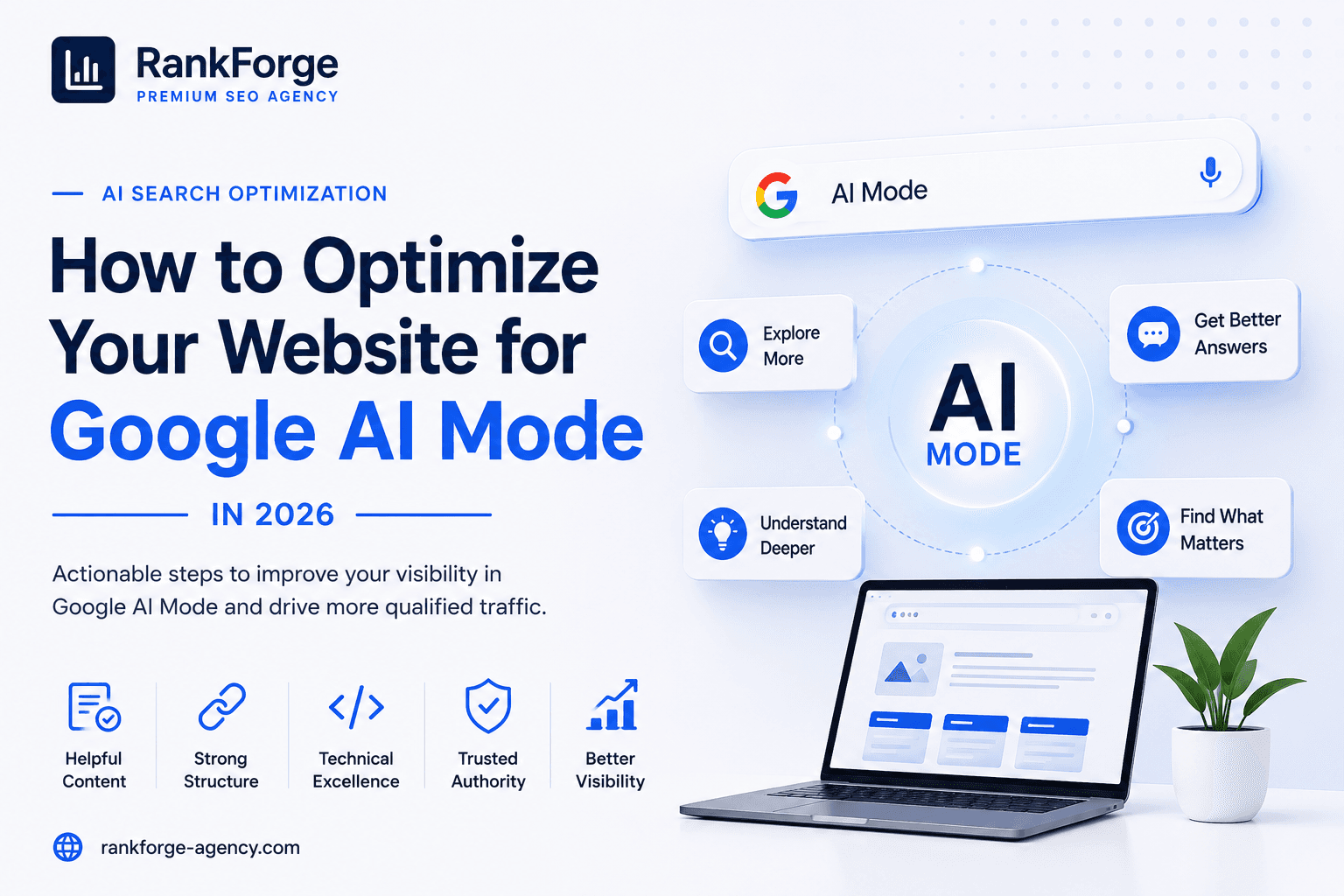
How to Optimize Your Website for Google AI Mode in 2026
Google Search is changing quickly.
With AI Mode and AI Overviews becoming an increasingly important part of the search experience, businesses are asking a practical question:
How do you optimize a website for Google AI Mode?
The good news is that Google does not require a completely separate type of SEO for AI Mode.
Google's current guidance says the same foundational SEO practices that help websites perform in traditional Search remain important for AI experiences. Pages still need to be crawlable, indexable, useful, technically sound, and valuable to users.
The difference is that AI-powered search can explore a query more deeply and connect users with supporting sources across multiple related searches.
That creates new opportunities for websites that demonstrate genuine expertise and provide useful, original information.
What Is Google AI Mode?
Google AI Mode is an AI-powered search experience designed for complex questions, exploration, comparisons, and follow-up searches.
Instead of requiring a user to perform several separate searches, AI Mode can help explore different aspects of a topic and provide a more comprehensive response.
Google describes this process as using techniques such as query fan-out, where related searches can be performed across different subtopics and sources.
For businesses, this means search visibility is no longer only about ranking for one exact keyword.
Your website can potentially become a supporting source for several related questions surrounding a topic.
score = (business_value * ranking_gap) / implementation_effortDoes Google AI Mode Require a Special SEO Strategy?
Not exactly.
Google's guidance states that there are no additional technical requirements specifically for appearing in AI Overviews or AI Mode.
A page generally needs to be indexed and eligible to appear in Google Search with a snippet.
That means your existing SEO foundation still matters.
Important areas include:
- Crawlability
- Indexability
- Helpful content
- Internal linking
- Page experience
- Textual content
- Structured data
- Relevant images and videos
- Accurate business information
Instead of trying to discover a secret "AI ranking factor," focus on building a website that Google can understand and users genuinely find useful.
1. Make Sure Google Can Crawl Your Website
AI search still depends on Google's search systems and index.
If Google cannot properly access your pages, those pages have a much harder time becoming useful sources for search features.
Start with the technical foundation.
Check:
- robots.txt
- XML sitemap
- HTTP status codes
- Canonical URLs
- Internal links
- Indexing directives
- JavaScript rendering
- Redirects
- Duplicate pages
- Server errors
A technical SEO audit can help identify problems that prevent important pages from being discovered or indexed efficiently.
For more information, see our Technical SEO Services.
2. Create Content That Answers Real Questions
AI Mode is designed around questions and exploration.
That makes search intent especially important.
Instead of creating a page simply because a keyword has search volume, identify what the user is actually trying to accomplish.
For example, someone searching:
"best SEO agency for dentists"
may actually want to know:
- What does dental SEO include?
- How long does SEO take for a dentist?
- How much does dental SEO cost?
- How do Google Business Profile rankings work?
- What keywords should a dental practice target?
- How can a dentist get more local leads?
A strong content strategy addresses the main topic while naturally covering the important related questions.
The goal is not to create hundreds of thin pages.
The goal is to build useful topical coverage.
3. Build Topic Depth Instead of Keyword Stuffing
One of the biggest mistakes businesses make with AI search is assuming that they need to repeat keywords more aggressively.
They don't.
A better approach is to build a connected group of useful pages around an important subject.
For example, a local SEO topic cluster could contain:
- Local SEO guide
- Google Business Profile optimization
- Local keyword research
- Local citations
- Local link building
- Local SEO technical audit
- Review strategy
- Local landing pages
These pages can support each other through contextual internal links.
This gives users more ways to explore the subject while helping search engines understand relationships between your pages.
4. Strengthen Internal Linking
Internal links are particularly valuable when building topical authority.
Make sure important pages can be reached through relevant contextual links.
For example:
Technical SEO Audit → Crawlability → Indexation → Core Web Vitals → Structured Data
Rather than adding links randomly, consider the user's next logical question.
If someone is reading about technical SEO audits, a relevant link to your technical SEO service is more useful than a generic "Learn More" link.
Use descriptive anchor text where appropriate and make sure your important commercial pages are not isolated.
5. Give Google Useful Text to Understand
Visual design is important, but critical information should not exist only inside images or visual components.
Make sure important information is available as readable HTML text.
This includes:
- Services
- Product information
- Business details
- FAQs
- Pricing information where appropriate
- Key features
- Locations
- Expertise
- Supporting explanations
A beautiful website that hides its most important information inside graphics can be harder for search systems to understand.
Good design and strong textual content should work together.
6. Use Structured Data Correctly
Structured data can help search engines understand the content and entities represented on a page.
However, structured data should not be treated as an AI ranking shortcut.
Use relevant structured data when it accurately represents the visible content on the page.
Depending on the website, this may include appropriate types such as:
- Organization
- LocalBusiness
- Article
- BreadcrumbList
- Product
- Service
The most important rule is consistency.
The information represented in structured data should accurately match the information users can see on the page.
Do not add markup simply because you believe it will make a page rank better in AI search.
7. Add Original Information and Experience
Generic content is easy to reproduce.
Original information is harder to replace.
If every SEO agency publishes the same generic article about "10 SEO Tips," there is little reason for a search system to rely heavily on any one version.
Instead, add information that demonstrates genuine expertise.
For example:
- Original case studies
- Real examples
- First-hand observations
- Screenshots
- Testing results
- Industry-specific recommendations
- Original research
- Unique frameworks
- Practical checklists
- Data from your own projects
This is especially important for competitive topics.
Your objective should be to create content that contributes something useful rather than simply rewriting what already exists.
8. Optimize for Related Questions
AI Mode can explore a topic through multiple related searches.
This means your content should anticipate reasonable follow-up questions.
Consider adding sections such as:
What is it?
Give the reader a clear definition.
Why does it matter?
Explain the business or practical impact.
How does it work?
Provide useful detail.
What problems should you watch for?
Address common issues.
How do you implement it?
Give actionable steps.
How do you measure results?
Explain relevant metrics.
This structure naturally creates content that supports deeper exploration.
9. Improve Page Experience
A page can contain excellent information and still provide a poor experience.
Check:
- Mobile usability
- Page speed
- Core Web Vitals
- Navigation
- Readability
- Layout stability
- Intrusive elements
- Font sizes
- Content hierarchy
Users coming from AI search should be able to quickly understand what your page offers.
Make the answer easy to find.
Avoid unnecessary popups, excessive animations, and visual clutter that distract from the main content.
10. Use Images and Other Media When They Add Value
AI-powered search is increasingly multimodal.
That makes useful visual content more valuable for appropriate topics.
Consider adding:
- Original screenshots
- Diagrams
- Product images
- Before-and-after examples
- Charts
- Process illustrations
- Videos
But don't add images simply to increase page length.
The media should help users understand the subject.
For SEO guides, for example, a screenshot of a real Search Console report can often be more useful than a generic stock image.
11. Keep Your Business Information Accurate
For businesses that depend on local or commercial search, keep important business information consistent and current.
Review:
- Google Business Profile
- Business name
- Address
- Phone number
- Website
- Services
- Business categories
- Opening hours
- Location information
For local businesses, this can support a broader search presence across traditional and AI-powered experiences.
You can also review our Local SEO Playbook for a deeper local search strategy.
12. Don't Chase AI SEO Hacks
The AI search ecosystem has created a large number of new optimization claims.
Be careful with promises such as:
- "Guaranteed AI Overview rankings"
- "Secret AI ranking signals"
- "One markup that makes ChatGPT recommend your business"
- "Guaranteed GEO rankings"
- "Special AI files required by Google"
Google's current guidance is much simpler.
Focus on:
Technical accessibility + helpful content + strong internal linking + relevant structured data + excellent user experience + genuine expertise.
Those fundamentals remain the foundation.
13. Don't Create Hundreds of AI-Generated Pages
Generative AI can be useful for research, outlining, editing, and improving workflows.
But publishing large quantities of low-value pages simply because AI makes production easier can create problems.
Every page should have a reason to exist.
Before publishing a new article, ask:
- Does this answer a real user need?
- Does it add something original?
- Is the information accurate?
- Does it overlap with another page?
- Does it support our broader topic?
- Can we demonstrate genuine expertise?
- Would a visitor actually find this useful?
Quality should determine publishing volume.
Not the other way around.
14. Measure AI Search Visibility
Google has introduced generative AI performance reporting in Search Console for a subset of websites.
These reports provide visibility into how pages appear within generative AI features and can include information such as:
- Impressions
- Pages
- Countries
- Devices
- Dates
Availability can vary as Google continues rolling out these capabilities.
Even when dedicated AI reporting is unavailable, continue monitoring your overall Search Console performance.
Look at:
- Impressions
- Clicks
- CTR
- Average position
- Top queries
- Top pages
- Country
- Device
Then connect search performance with analytics and business conversions.
The objective is not simply to appear in an AI answer.
The objective is to attract qualified visitors and generate business value.
Google AI Mode SEO Checklist
Before publishing or optimizing an important page, review this checklist:
- [ ] Googlebot can crawl the page
- [ ] The page is indexable
- [ ] The page returns a successful HTTP status
- [ ] Important content is available as text
- [ ] The page answers a clear search intent
- [ ] Content provides original value
- [ ] Relevant internal links are included
- [ ] Structured data accurately represents visible content
- [ ] Images support the topic
- [ ] Mobile experience is strong
- [ ] Core Web Vitals are monitored
- [ ] Business information is accurate
- [ ] The page does not duplicate another page
- [ ] Content is reviewed for accuracy
- [ ] Search performance is being measured
Final Takeaway
Optimizing for Google AI Mode does not require abandoning traditional SEO.
It requires doing the fundamentals well while creating content that is genuinely useful for deeper, more conversational searches.
Build a technically accessible website.
Create original, people-first content.
Connect related topics with strong internal links.
Use structured data accurately.
Improve page experience.
Add useful visual content where appropriate.
And most importantly, focus on providing information that deserves to be discovered.
Google's own guidance makes the direction clear: strong SEO fundamentals remain relevant as Search evolves into AI-powered experiences.
For businesses that want to improve technical foundations, search visibility, and AI-search readiness, a structured SEO strategy is a much stronger long-term approach than chasing individual AI-search hacks.
Ready to turn this into a roadmap?
RankForge can audit your site, prioritize the best opportunities, and build the growth system behind them.
Request free audit