Google’s “Highly Cited” Badge: What It Means for SEO in 2026
Learn what Google’s Highly Cited badge means for SEO, original content, authority, and visibility across AI Search in 2026.
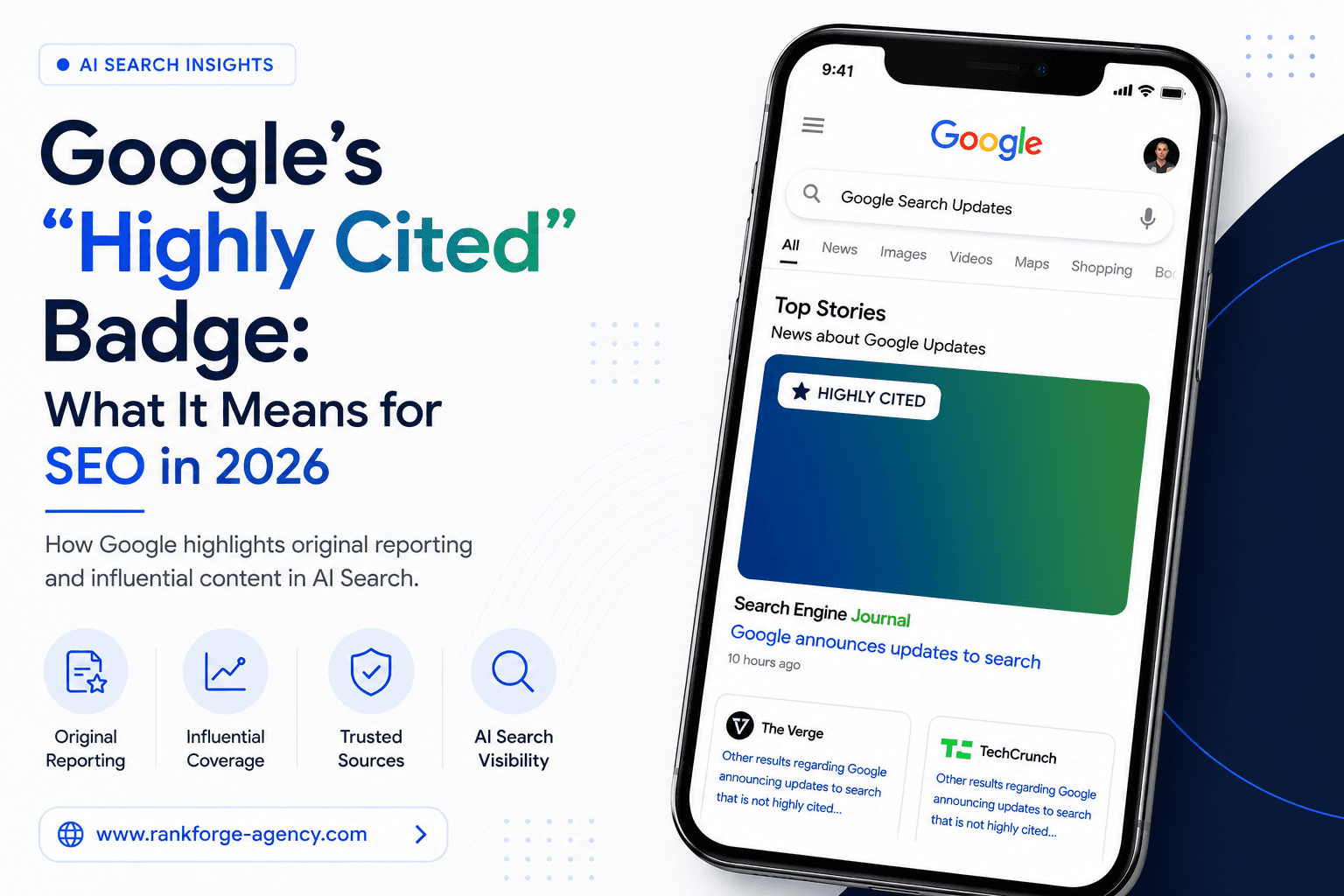
Google’s “Highly Cited” Badge: What It Means for SEO in 2026
Google Search is changing how people discover information.
As AI-powered search becomes a larger part of the search experience, Google is introducing new ways to help users identify useful, original, and influential sources.
One of those developments is the “Highly Cited” badge.
Introduced as part of Google's broader AI Search updates, the badge is designed to help users identify search results associated with original reporting and influential coverage.
For SEO professionals, this raises an important question:
What does being highly cited mean for your website, and how should your content strategy adapt?
The answer is not to chase a badge.
The bigger opportunity is to become the source that other websites, researchers, publishers, and search systems have a reason to reference.
What Is Google's Highly Cited Badge?
Google introduced a “Highly Cited” badge to help users identify original reporting and influential coverage in Search.
The feature is part of Google's broader effort to help people find high-quality content and firsthand perspectives as AI-powered search evolves.
Instead of looking only at traditional ranking positions, users can receive additional context about sources that have been cited or referenced widely.
This creates another reason for publishers and businesses to think about the authority of their content.
score = (business_value * ranking_gap) / implementation_effortWhy Does This Matter for SEO?
Traditional SEO often focuses on questions such as:
- What keyword should we target?
- What is the search volume?
- How difficult is the keyword?
- How many backlinks do competitors have?
- How can we improve our ranking?
Those questions still matter.
But AI Search introduces another important question:
Is our content valuable enough to be referenced?
That changes the way content teams should think.
Instead of creating another article that repeats information already available everywhere, businesses should look for opportunities to produce something genuinely useful, original, or authoritative.
Ranking Is Not the Same as Being Cited
A highly cited page and a high-ranking page are not necessarily the same thing.
A page can rank well for a keyword without becoming an important reference for the broader topic.
Similarly, an original study or unique piece of reporting may become influential because other sources reference it.
This distinction is important.
SEO should not become a race to create pages that simply match existing search results.
It should also involve creating information that contributes something new.
What Makes Content Worth Citing?
There is no single formula that guarantees citation.
However, certain characteristics can make content more valuable as a source.
Original Research
Research creates information that other websites cannot simply copy.
Examples include:
- Industry surveys
- First-party data
- Search performance studies
- Original experiments
- Customer research
- Market analysis
- Technical testing
If you discover something useful, other writers have a reason to reference your findings.
First-Hand Experience
Content based on real experience can be more useful than generic summaries.
For example:
Instead of writing:
“Core Web Vitals are important for SEO.”
A stronger article might analyze performance data across a group of websites and explain which technical problems appeared most often.
The second approach contributes actual information.
Unique Analysis
You don't always need proprietary data.
You can also create value through strong analysis.
For example:
- Compare multiple approaches
- Analyze a Google update
- Explain a complicated technical change
- Break down industry trends
- Identify patterns in search results
- Explain what a new feature means for businesses
The important part is adding your own useful interpretation.
1. Stop Creating Content That Says the Same Thing
One of the biggest problems in modern SEO is content duplication at the idea level.
Two pages may use completely different wording while providing essentially the same information.
This creates a huge amount of content but very little new value.
Before publishing an article, ask:
What does this page add that the existing results do not?
If the answer is difficult to explain, the content probably needs a stronger angle.
2. Build Content Around Original Information
A strong content strategy should include pages that can become reference points.
For an SEO agency, this might include:
- Technical SEO studies
- Search Console analyses
- Website performance research
- AI Search experiments
- Local SEO studies
- Industry benchmarks
- SEO case studies
- Original frameworks
- Technical checklists
These assets can support many other articles.
For example, an original study about local SEO performance could become the source for:
- A detailed research article
- Several supporting blog posts
- Social media content
- A downloadable report
- Industry commentary
- Client presentations
One strong piece of research can therefore create a much larger content ecosystem.
3. Make Data Easy to Understand
If you publish original data, presentation matters.
Use:
- Clear charts
- Tables
- Explanations
- Methodology
- Definitions
- Key findings
- Sources
- Publication dates
Don't simply publish a spreadsheet and expect users to understand it.
Explain what the data means.
Good analysis turns information into something useful.
4. Show Your Methodology
If you're publishing research, explain how you reached your conclusions.
Include information such as:
- Sample size
- Data source
- Date range
- Method
- Limitations
- Definitions
- Analysis process
This increases transparency and makes the research easier for others to evaluate.
It also gives journalists, researchers, and industry writers more confidence when deciding whether to reference your work.
5. Strengthen Author Expertise
Original content becomes more credible when readers understand who created it.
For important content, clearly communicate:
- Author
- Professional experience
- Relevant expertise
- Organization
- Methodology
- Sources
For technical SEO content, for example, explain the experience or research behind your recommendations.
Don't hide expertise behind anonymous generic articles.
6. Build a Recognizable Brand
Citations and mentions can also contribute to brand visibility.
A website that consistently publishes useful information becomes easier to recognize.
Your content should make it clear:
Who produced this?
What does this brand know about?
Why should I trust this source?
For RankForge, that means consistently building around areas such as:
- Technical SEO
- AI Search
- Local SEO
- Entity SEO
- Structured Data
- Core Web Vitals
- Search visibility
A focused content identity is stronger than publishing unrelated articles simply because they have search volume.
7. Connect Research With Your Existing Content
Original research should not exist as an isolated page.
Connect it with relevant supporting content.
For example:
Original SEO research
↓
Technical SEO guide
↓
Search Console analysis
↓
Core Web Vitals guide
↓
SEO service page
This creates a strong internal linking structure.
It also allows users to move from research to explanation to practical implementation.
For internal SEO, see our Technical SEO Services.
8. Use External Sources Carefully
Original content does not mean ignoring other sources.
Strong research often builds on reliable information from:
- Google Search Central
- Search Console
- Government datasets
- Academic research
- Industry organizations
- Official documentation
- First-party company data
Clearly identify your sources.
Then explain what your own analysis adds.
This distinction is important:
Source information + your analysis = useful original content.
Simply rewriting somebody else's information is not the same thing.
9. Create Content Other People Want to Reference
Think beyond your own audience.
Ask:
Would another writer link to this?
Would a journalist find this useful?
Would an SEO professional reference this data?
Would a business use this research to make a decision?
If the answer is yes, you are moving toward reference-worthy content.
This is a much stronger goal than simply trying to make every article longer than the competitor.
10. Don't Manufacture Citations
The goal is not to manipulate the Highly Cited badge.
Avoid strategies such as:
- Creating fake statistics
- Publishing meaningless surveys
- Inventing research
- Building pages purely to attract mentions
- Creating artificial citation networks
- Repeating unsupported claims
- Publishing low-quality content at scale
The strongest strategy is much simpler:
Create something worth referencing.
11. Update Important Research
Research can become outdated.
If you publish:
“SEO Performance Benchmarks for 2026”
the information may become less useful as the year progresses.
Maintain important research assets.
When updating them:
- Preserve the original publication date where appropriate
- Add a clear update date
- Explain what changed
- Update outdated statistics
- Review conclusions
- Keep historical context where useful
This helps users understand whether they are reading current information.
12. Think About AI Search Differently
AI Search can summarize information from multiple sources.
That means your content may contribute to an answer even when the user does not begin with your brand name.
This creates an important opportunity.
Instead of asking only:
“How do we rank for this keyword?”
also ask:
“What information could our website become known for?”
That could be:
- A unique dataset
- A technical methodology
- A useful framework
- An industry benchmark
- A detailed case study
- Original research
- First-hand expertise
This is where SEO and brand authority increasingly overlap.
13. Measure More Than Rankings
Traditional metrics remain useful:
- Impressions
- Clicks
- CTR
- Average position
- Organic traffic
- Conversions
But content teams should also watch for broader authority signals.
Look for:
- Brand mentions
- Referral traffic
- Backlinks
- Citations
- Publisher references
- Industry mentions
- Search queries containing your brand
- AI Search visibility where reporting is available
Google has also introduced generative AI performance insights in Search Console, giving eligible websites additional visibility into how their pages appear in AI-powered Search experiences.
For a deeper look at Search Console data, see our Google Search Console Crawl Stats guide.
A Practical “Highly Cited” Content Framework
If you want to create content with genuine reference value, use this framework.
Step 1: Find an unanswered question
Look for a problem where existing content is incomplete, outdated, or too generic.
Step 2: Gather reliable data
Use first-party information or authoritative external sources.
Step 3: Add original analysis
Explain what the information means.
Step 4: Make the findings useful
Give readers practical conclusions.
Step 5: Document your methodology
Show how you reached your conclusions.
Step 6: Make the content easy to reference
Use clear headings, statistics, charts, definitions, and concise findings.
Step 7: Promote the research
Share it with relevant audiences, publications, communities, and industry professionals.
Step 8: Maintain it
Update the research when important information changes.
Example for an SEO Agency
Imagine an SEO agency publishes:
“Technical SEO Problems Found Across 500 Service-Business Websites: 2026 Study.”
The report identifies:
- Most common indexing problems
- Average Core Web Vitals failures
- Common canonical mistakes
- Internal linking patterns
- Sitemap issues
- Mobile performance problems
The agency then publishes the methodology and findings.
Other SEO professionals can reference the statistics.
Industry writers can discuss the findings.
Businesses can use the recommendations.
The research becomes more than a blog post.
It becomes an authority asset.
That is the kind of content modern SEO teams should be trying to create.
Highly Cited Content Checklist
Before publishing an important research or insight article, ask:
- [ ] Does it provide original information?
- [ ] Is the topic genuinely useful?
- [ ] Are the sources reliable?
- [ ] Is the methodology explained?
- [ ] Are important claims supported?
- [ ] Does the article contain original analysis?
- [ ] Is the author expertise clear?
- [ ] Are statistics easy to understand?
- [ ] Can another website reference the findings easily?
- [ ] Does the page have useful internal links?
- [ ] Is the content technically accessible?
- [ ] Will the information remain useful over time?
- [ ] Is there a plan to update it?
The Bigger Lesson for SEO
Google's Highly Cited feature is part of a broader shift toward helping users discover useful sources in AI-powered Search.
That does not mean traditional SEO is disappearing.
Technical SEO still matters.
Search intent still matters.
Internal linking still matters.
Structured data still matters.
Page experience still matters.
But content strategy is becoming increasingly important as well.
The strongest websites will not simply publish the most content.
They will publish some of the most useful information within their areas of expertise.
Final Takeaway
The emergence of Google's Highly Cited badge highlights an important principle for SEO in 2026:
Don't just create content that ranks. Create content that deserves to be referenced.
That means investing in original research, first-hand experience, useful analysis, transparent methodology, and genuinely valuable information.
You cannot guarantee that Google will label your content as highly cited.
You can, however, build content that other people have a reason to mention, reference, and trust.
And that is a much stronger long-term SEO strategy.
Ready to turn this into a roadmap?
RankForge can audit your site, prioritize the best opportunities, and build the growth system behind them.
Request free audit