Google Search Console AI Search Report: How to Measure AI Overviews & AI Mode Visibility in 2026
Learn how Google's new Search Console AI performance report measures AI Overviews and AI Mode visibility and how to use the data for SEO.
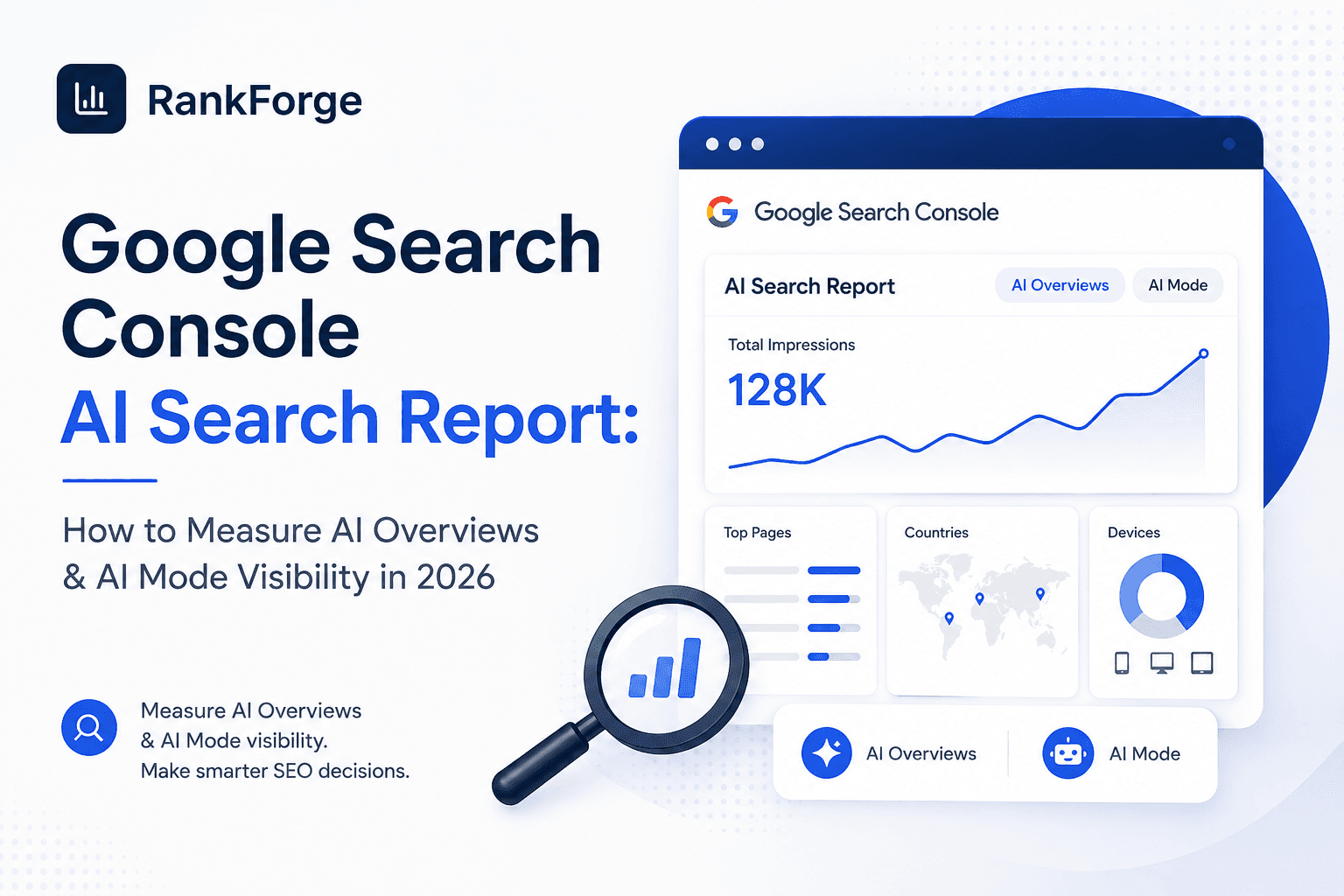
Google Search Is Changing — and Measurement Is Changing With It
Google Search is no longer limited to a list of traditional blue links.
AI Overviews and AI Mode are changing how people discover information, compare businesses, research products, and decide which websites to visit. For SEO teams, that creates a new question:
How do you actually measure whether your website is becoming more visible in Google's AI search experiences?
Google has now introduced a dedicated Generative AI performance report in Search Console for Google Search. The report provides visibility data for generative AI features including AI Overviews and AI Mode.
This gives website owners a new way to understand how their pages are appearing in Google's AI-powered search experiences alongside their traditional organic search performance.
The report is currently being rolled out to a subset of website owners, so not every Search Console property will have access yet.
What Is the Google Search Console AI Performance Report?
The Generative AI performance report is a dedicated Search Console report for measuring your site's performance in Google's generative AI features on Search.
Google launched the Search version of the report in June 2026. It includes data from two major generative AI experiences:
- AI Overviews
- AI Mode
The purpose is straightforward: help website owners understand how often their pages are being shown as links within Google's generative AI search experiences.
This is important because traditional SEO reporting does not tell the complete story anymore.
A website can have strong organic visibility while also gaining or losing visibility within AI-generated search experiences.
The new report gives SEO teams a dedicated place to begin measuring that difference.
score = (business_value * ranking_gap) / implementation_effortWhat Does the AI Search Report Measure?
The report focuses primarily on impressions.
Google defines these impressions as the times links to your website were shown to a user within a generative AI feature on Google Search.
You can break the data down using several dimensions.
| Dimension | What it tells you |
|---|---|
| Pages | Which URLs are receiving AI-search impressions |
| Countries | Where your AI-search visibility is coming from |
| Devices | Whether visibility is coming from mobile, desktop, or tablet |
| Dates | How generative AI visibility changes over time |
This makes the report useful for identifying which pages are becoming visible in AI search and where that visibility is occurring.
AI Overviews vs. AI Mode
The report currently includes both AI Overviews and AI Mode, but these experiences are not identical.
AI Overviews
AI Overviews can appear above or alongside traditional search results when Google's systems determine that an AI-generated summary can help answer a user's query.
The experience can provide links to supporting web content, giving users opportunities to continue researching the topic.
For SEO teams, this means a page may gain visibility as a supporting source even when the user does not interact with a traditional organic result in the same way.
AI Mode
AI Mode provides a more conversational search experience.
Users can ask more complex questions, explore a topic through follow-up questions, and continue researching within the same search experience.
Google's AI features can use different models and techniques, so the pages and responses shown can vary between AI Overviews, AI Mode, and traditional Search.
That is one reason why AI-search visibility should not be treated as a simple replacement for traditional keyword rankings.
Why AI Search Impressions Matter
Impressions are not the same thing as clicks, leads, or revenue.
However, they provide an important visibility signal.
Consider three different websites.
Website A: Strong organic and AI visibility
The site ranks well organically and is also receiving significant AI-search impressions.
This suggests the site has visibility across multiple Google search experiences.
Website B: Strong organic visibility but limited AI visibility
The site receives traditional organic impressions but comparatively little visibility from generative AI features.
This can become an opportunity to investigate whether the site's content fully addresses the broader questions and topics surrounding its target searches.
Website C: Weak organic and AI visibility
If a site has limited visibility in both traditional Search and generative AI features, the priority should usually be the SEO foundation first.
That means reviewing:
- Crawlability
- Indexability
- Search intent
- Content quality
- Internal linking
- Technical SEO
- Page experience
- Authority and relevance
AI search optimization should not become an excuse to ignore fundamental SEO.
What the Report Does Not Tell You
The new report is useful, but it is important not to overinterpret it.
It does not provide a complete picture of your AI-search strategy.
For example, the report does not automatically tell you:
- The exact user prompt that triggered an appearance
- Why Google selected your page
- Which specific passage influenced an AI response
- Whether an AI-search impression produced a lead
- Whether a particular mention directly generated revenue
- Your complete visibility across every external AI platform
It is therefore better to think of the report as a Google AI-search visibility measurement layer, not a complete AI attribution platform.
Your broader reporting system can combine Search Console data with organic rankings, analytics, conversions, content performance, and other AI-search monitoring sources.
How to Find the AI Performance Report in Search Console
If your property has access to the report, you can use Search Console to review your generative AI performance.
Start by:
- Opening Google Search Console.
- Selecting your verified website property.
- Opening the Generative AI performance report for Search.
- Reviewing the total impressions for the selected date range.
- Switching between Pages, Countries, Devices, and Dates.
- Comparing changes over time.
- Exporting the data when you need to combine it with your broader SEO reporting.
Google is still rolling the report out gradually, so the absence of the report does not necessarily mean there is a problem with your website.
Your property may simply not have access yet.
How to Analyze Your AI Search Visibility
Don't look at the total number of impressions alone.
The most useful analysis starts with the pages receiving visibility.
1. Find your top AI-visible pages
Open the Pages dimension and identify which URLs receive the most impressions.
Then ask:
- What topic does the page cover?
- What search intent does it address?
- Is the page commercial, informational, or navigational?
- Does it have supporting content elsewhere on the site?
- Is it connected to a larger topic cluster?
- Does the page provide information that is genuinely useful beyond a basic definition?
This can help you identify the content Google is already finding useful within its AI search experiences.
2. Look for pages with strong traditional SEO but weak AI visibility
A page may receive substantial traditional organic visibility without receiving comparable visibility in generative AI features.
That does not automatically mean the page is underperforming.
Instead, use the difference as a diagnostic signal.
Review whether the page:
- Clearly answers the main question
- Covers related questions
- Provides original information
- Uses clear headings
- Has strong internal links
- Provides useful supporting evidence
- Fits naturally within the site's broader topic structure
3. Analyze countries
The Countries dimension can show where your AI-search visibility is originating.
This can be particularly useful for businesses serving multiple markets.
For example, a company targeting the United States, United Kingdom, and Canada may discover that AI-search visibility is concentrated in one market.
That can lead to additional questions around:
- Content localization
- Search demand
- Market-specific topics
- Service-area relevance
- Local SEO
- Entity signals
4. Compare devices
The Devices dimension separates visibility across mobile, desktop, and tablet.
This matters because AI search visibility ultimately leads users to pages that still need to perform well on their devices.
If AI-search visibility is growing but the landing experience is slow or difficult to use on mobile, the visibility opportunity may not translate into business results.
AI Search Visibility Is Not the Same as Traditional Rankings
Traditional SEO reporting often focuses on metrics such as:
- Keyword rankings
- Organic impressions
- Organic clicks
- CTR
- Average position
AI search introduces another layer.
| Traditional SEO | AI Search |
|---|---|
| Keyword rankings | Generative AI visibility |
| Search positions | Supporting links and sources |
| Organic clicks | AI-search impressions and downstream engagement |
| Individual queries | Broader questions and topic relationships |
| SERP visibility | AI-generated search experience visibility |
| Ranking reports | Visibility + content + business reporting |
This does not mean traditional rankings no longer matter.
Google's own guidance says that the same foundational SEO best practices remain relevant for AI Overviews and AI Mode.
The better approach is to measure both.
Do You Need Special SEO Techniques for AI Overviews?
This is where a lot of AI-search advice becomes unnecessarily complicated.
Google's current guidance is clear: there are no additional technical requirements or special schema requirements specifically required to appear in AI Overviews or AI Mode.
A page must be indexed and eligible to appear in Google Search with a snippet.
That means the fundamentals still matter.
Your website should:
- Allow Google to crawl important content
- Make important pages indexable
- Use clear internal links
- Provide helpful, reliable, people-first content
- Make important information available in text
- Provide a strong page experience
- Use structured data accurately when appropriate
- Keep structured data consistent with visible page content
In other words:
AI search does not eliminate SEO fundamentals. It makes strong fundamentals more valuable.
How to Prepare Your Website for AI Search
Instead of trying to create an entirely separate "AI SEO" website, build a stronger search ecosystem.
Build useful topic coverage
Answer the primary question, but also address the important related questions a real customer would ask.
For example, an SEO agency targeting technical SEO could build a connected content system covering:
- What is technical SEO?
- What does a technical SEO audit include?
- How much does a technical SEO audit cost?
- How often should a technical SEO audit be performed?
- Technical SEO checklist
- Core Web Vitals
- Crawlability and indexation
- Structured data
- JavaScript SEO
The goal is not to publish content for the sake of volume.
The goal is to build useful coverage around a meaningful topic.
Strengthen internal linking
Internal links help users and search engines discover related content.
A strong topic cluster might connect:
Technical SEO
↓
Technical SEO Audit
↓
Core Web Vitals
↓
Structured Data
↓
JavaScript SEO
↓
SEO Services
This creates a clearer relationship between individual pages.
Add original value
AI search makes commodity content easier to reproduce.
That increases the importance of information that actually adds value.
Depending on your industry, this could include:
- Original research
- First-hand observations
- Case studies
- Data
- Expert analysis
- Examples
- Comparisons
- Practical frameworks
- Original processes
The objective should not be to write content that sounds more "AI optimized."
The objective should be to create content that deserves to be discovered.
How to Build an AI Search Measurement System
Search Console should be one component of a larger reporting framework.
A practical SEO and AI-search reporting system can look like this:
| Layer | What to measure |
|---|---|
| Technical SEO | Crawlability, indexation, Core Web Vitals |
| Organic Search | Clicks, impressions, CTR, rankings |
| AI Search | AI Overviews and AI Mode impressions |
| Content | Page performance, engagement, topic coverage |
| Authority | Relevant links, mentions, entity signals |
| Conversion | Leads, calls, forms, sales |
| Business | Qualified pipeline and revenue influence |
This prevents the common mistake of treating AI-search visibility as the final business metric.
Visibility is valuable.
But the ultimate goal is still to create a business outcome.
A Note About Recent Search Console Data
If you are analyzing very recent AI performance data, be careful about drawing conclusions from short date ranges.
Google reported a logging issue that affected impressions in the Generative AI performance report for Search from August 13 through August 17, 2026.
This means unusually low impression numbers during that period may not represent a real change in visibility.
When working with fresh data, allow time for reporting to stabilize and compare longer periods whenever possible.
What Should SEO Teams Do Now?
If your Search Console property already has access to the Generative AI performance report, start building a baseline.
Record:
- Total AI-search impressions.
- Top AI-visible pages.
- Countries generating visibility.
- Device distribution.
- Changes over time.
- Pages gaining visibility.
- Pages losing visibility.
Then connect those findings to your existing SEO data.
For example:
AI visibility increases + organic visibility increases
This is a strong combined visibility signal.
AI visibility increases + organic clicks decrease
Investigate whether the search experience is changing the relationship between impressions and clicks.
AI visibility decreases + organic visibility remains stable
Review whether your topic coverage, content relevance, or AI-search visibility has changed.
Both decrease
Start with technical SEO, indexing, content relevance, and search demand before assuming the issue is AI-specific.
The Future of SEO Is Not "AI SEO Instead of SEO"
The most useful way to think about AI search is not as a replacement for SEO.
It is another layer of search discovery.
Google's AI features still depend on content that can be discovered, crawled, indexed, understood, and retrieved from the Search index.
That means the fundamentals remain important:
Technical accessibility → relevant content → topical coverage → internal linking → authority → search visibility → conversions
AI search adds another visibility surface to that system.
The brands that benefit will not necessarily be the ones publishing the most AI-generated content.
They will be the ones creating useful, trustworthy, technically accessible information that search systems can understand and users actually want to consume.
Final Takeaway
Google Search Console's new Generative AI performance report gives SEO teams something they have needed for a long time: a direct Google reporting layer for visibility within AI Overviews and AI Mode.
It is not a complete AI-search analytics platform, and it should not replace traditional SEO reporting.
Instead, use it alongside your existing data.
Track which pages are gaining AI visibility.
Understand where that visibility is coming from.
Connect AI-search performance with organic search, content engagement, leads, and revenue.
And most importantly, keep building the fundamentals that make a website useful to both people and search systems.
AI search is changing the interface of search. Strong SEO remains the foundation underneath it.
Frequently Asked Questions
What is the Google Search Console AI performance report?
It is a Search Console report that provides visibility data for your website's appearances in Google's generative AI search features, including AI Overviews and AI Mode.
Does Google Search Console show AI Overviews?
Yes. Google's Generative AI performance report for Search includes impressions from AI Overviews and AI Mode.
Does Search Console show AI Mode visibility?
Yes. AI Mode is included in Google's current Generative AI performance report for Search.
Does every website have access to the AI performance report?
No. Google is rolling the report out gradually to a subset of website properties.
Does the AI performance report show clicks?
The dedicated report focuses on generative AI impressions and related dimensions. It should be used alongside the standard Search Console performance report and analytics when evaluating clicks and business outcomes.
Do I need special schema to appear in AI Overviews?
No. Google says there is no special schema markup required specifically for AI Overviews or AI Mode. Existing SEO fundamentals remain important.
Is SEO still important for AI search?
Yes. Google states that its existing SEO best practices continue to apply to AI search features, including crawlability, indexability, internal linking, helpful content, page experience, and accurate structured data.
Ready to turn this into a roadmap?
RankForge can audit your site, prioritize the best opportunities, and build the growth system behind them.
Request free audit