Google Preferred Sources: How to Get Your Website Noticed in AI Search
Learn how Google Preferred Sources works in AI Mode and AI Overviews, who can use it, and how businesses can build stronger visibility and trust in AI Search.
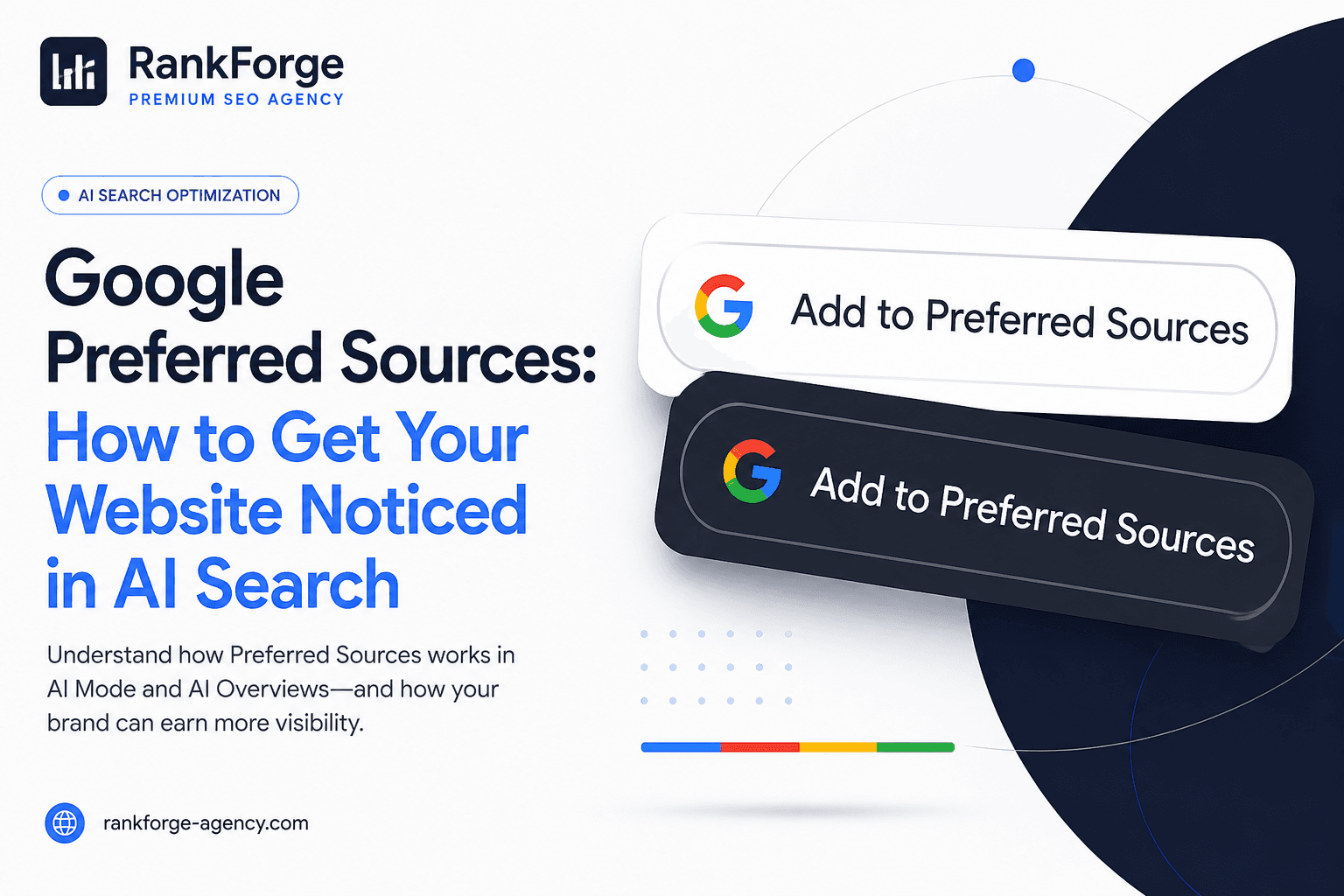
Google Preferred Sources: How to Get Your Website Noticed in AI Search
Google Search is becoming more personalized.
In 2026, Google has expanded its Preferred Sources feature into AI-powered search experiences, including AI Mode and AI Overviews.
The idea is simple: users can tell Google which websites they prefer to see, and those selected sources can receive special treatment in relevant search experiences.
For publishers, brands, and businesses investing in SEO, this creates an interesting new layer of search visibility.
But it is important to understand what Preferred Sources actually does—and what it does not do.
What Are Google Preferred Sources?
Preferred Sources allow Google users to select websites they want to see more often in Search.
Google says that selected sources can be highlighted in Top Stories and can receive a "preferred" badge in AI Mode and AI Overviews.
The feature is designed around user preference.
Instead of Google deciding that every user should see exactly the same sources, users can identify websites they personally trust or want to follow.
This makes brand recognition and audience relationships increasingly important in search.
score = (business_value * ranking_gap) / implementation_effortWhy Preferred Sources Matter for AI Search
Traditional SEO focuses heavily on earning visibility for relevant queries.
AI search adds another dimension.
A user may ask an AI-powered search system a complex question and receive an answer that includes links to supporting websites.
If that user has already selected a website as a Preferred Source, Google can highlight that source in relevant AI experiences.
This means a website's relationship with its audience can become more important.
Search visibility is not only about being discovered.
It is also about being remembered and trusted.
Where Can Preferred Sources Appear?
Google's current documentation says Preferred Sources can be used across several Search experiences.
These include:
- Top Stories
- AI Overviews
- AI Mode
The exact presentation depends on the Search experience and the user's settings.
In AI Mode and AI Overviews, a selected source can receive a "preferred" badge.
This helps distinguish it from other sources that appear in the AI experience.
How Does a User Select a Preferred Source?
Users can manage their source preferences through Google Search personalization settings.
They can search for a website or source and select it as a preferred source.
Google also provides publishers with a way to make this process easier.
A website can add a custom interactive Preferred Sources button that guides readers through the process.
Google's documentation also provides a deeplink option for websites that cannot use the JavaScript implementation.
Does the Preferred Sources Button Improve Rankings?
This is one of the most important distinctions.
The Preferred Sources feature should not be treated as a traditional SEO ranking hack.
Google's documentation describes the feature as a way for users to select sources they want to see more prominently.
In AI Mode and AI Overviews, the result is a preferred badge for users who have selected that source.
That is different from saying:
"Add this button and your rankings will increase."
SEO professionals should avoid making that claim.
Instead, think of Preferred Sources as an audience and visibility feature.
Who Can Benefit From Preferred Sources?
The feature can be particularly interesting for organizations that regularly publish useful content.
Potential examples include:
- Publishers
- News websites
- Industry publications
- Research organizations
- Expert brands
- Agencies
- Educational websites
- Established businesses with strong content programs
For businesses, the bigger opportunity may be building enough trust and recognition that users actively want to see the brand's content.
1. Build a Recognizable Brand
People are more likely to select sources they recognize and trust.
That makes brand visibility an important part of modern SEO.
Your website should clearly communicate:
- Who you are
- What you specialize in
- Who you serve
- Why your information is credible
- What makes your perspective different
A generic website with interchangeable content gives users little reason to remember it.
A distinctive brand gives them a reason to return.
2. Publish Content Worth Following
Preferred Sources are based on user preference.
That means content quality matters.
Ask yourself:
Would someone actively want to see more content from this website?
If the answer is no, adding a Preferred Sources button will not solve the underlying problem.
Create content that is:
- Useful
- Original
- Accurate
- Specific
- Well researched
- Relevant to your audience
- Updated when necessary
The objective should be to create a publication users trust—not simply more pages for search engines.
3. Establish a Clear Topic
A website should have a recognizable area of expertise.
For example, RankForge focuses on areas such as:
- Technical SEO
- AI Search Optimization
- Local SEO
- Entity SEO
- Structured Data
- Core Web Vitals
- Search visibility
This creates a clear relationship between the brand and the subjects it covers.
A clear topical identity can make content easier for both users and search systems to understand.
4. Create Consistent Publishing Habits
Google's Preferred Sources documentation notes that sources that are not updated regularly may not be available in the source-selection experience.
That makes consistency important for publishers.
However, consistency does not mean publishing low-quality content every day.
A better approach is:
Publish useful content consistently.
For an SEO agency, this could include:
- Google Search updates
- Technical SEO guides
- AI Search analysis
- Case studies
- Search Console tutorials
- Local SEO research
- Industry-specific SEO strategies
5. Make Your Content Easy to Discover
If users cannot easily understand what your website is about, they have less reason to follow it.
Make your site structure clear.
Important areas should include:
- Homepage
- Services
- Blog
- About
- Case studies
- Contact
Your navigation should help visitors quickly understand your expertise.
Internal linking should connect related topics naturally.
For example:
Technical SEO
→ Crawlability
→ Indexation
→ Search Console
→ Core Web Vitals
→ Structured Data
This creates a stronger content ecosystem.
6. Strengthen Your Author and Brand Signals
AI-powered search makes it increasingly important to demonstrate who is behind the information.
Where appropriate, clearly communicate:
- Author names
- Author expertise
- Company information
- Editorial standards
- Experience
- Original research
- Case studies
For agency websites, real expertise is much more valuable than generic AI-generated content.
7. Use Original Information
One of the strongest ways to differentiate a website is to publish information that cannot easily be copied from another page.
Consider creating:
- Original research
- Client case studies
- Search performance analysis
- Experiments
- Data studies
- Industry surveys
- Technical audits
- First-hand observations
- Unique frameworks
This gives people a reason to follow your website rather than simply finding another generic article.
8. Don't Confuse Preferred Sources With Traditional Rankings
This distinction deserves emphasis.
Preferred Sources are personalized.
A user selecting your site does not mean that your website suddenly ranks first for everyone.
The benefit is tied to users who have chosen your source.
Therefore, businesses should not abandon traditional SEO.
Continue investing in:
- Technical SEO
- Search intent
- Content quality
- Internal linking
- Structured data
- Page experience
- Authority
- Local SEO where relevant
Preferred Sources should complement your SEO strategy.
They should not replace it.
9. Connect Preferred Sources With AI Search Strategy
AI search optimization should be viewed as a complete ecosystem.
Think about the journey:
Brand discovery
↓
Useful content
↓
User trust
↓
Preferred Source selection
↓
Greater visibility in relevant AI experiences
This is different from simply trying to rank one page for one keyword.
The long-term objective is to become a source that users recognize and actively want to see.
10. Should Every Business Add the Button?
Not necessarily.
If your website has a strong content strategy and an audience that regularly reads your material, the feature may be worth testing.
But adding a button should not be your first priority if your website has bigger problems.
First make sure you have:
- Strong technical SEO
- Useful content
- Clear positioning
- Good user experience
- Consistent publishing
- Strong internal linking
- Accurate structured data
- A recognizable brand
Then consider Preferred Sources as an additional visibility opportunity.
Google Preferred Sources Checklist
Before promoting your website as a preferred source, review:
- [ ] Website has a clear purpose
- [ ] Brand is easy to recognize
- [ ] Content serves a defined audience
- [ ] Articles provide genuine value
- [ ] Content is regularly maintained
- [ ] Important pages are crawlable
- [ ] Internal links are strong
- [ ] Authors and expertise are clear
- [ ] Original information is published
- [ ] Website has a strong technical foundation
- [ ] Search Console is monitored
- [ ] AI-search visibility is being evaluated
- [ ] Preferred Sources implementation is tested
What Preferred Sources Mean for SEO in 2026
The evolution of Google Search shows that search visibility is becoming more than a simple ranking position.
Users increasingly interact with search through:
- AI Overviews
- AI Mode
- Traditional results
- Top Stories
- Personalized experiences
That means successful SEO increasingly combines technical accessibility, useful content, authority, brand recognition, and user trust.
Preferred Sources are one example of this shift.
Google is giving users more control over which sources they want to see.
For brands, that creates a new challenge:
Become the source people actually want to follow.
Final Takeaway
Google Preferred Sources should not be viewed as another shortcut for rankings.
It is better understood as a bridge between brand trust, audience preference, and AI-powered search visibility.
If people recognize your website, value your content, and want to see more from you, Preferred Sources gives them a way to signal that preference to Google.
For SEO teams, the lesson is straightforward:
Don't just optimize pages for search engines.
Build a website that people remember, trust, and want to return to.
That is a much stronger foundation for visibility as Google Search continues moving toward AI-powered experiences.
Ready to turn this into a roadmap?
RankForge can audit your site, prioritize the best opportunities, and build the growth system behind them.
Request free audit