Google AI Max for Search Campaigns: What Advertisers Need to Know in 2026
Learn what Google AI Max changes for Search campaigns in 2026, which legacy features are transitioning, and how advertisers should prepare.
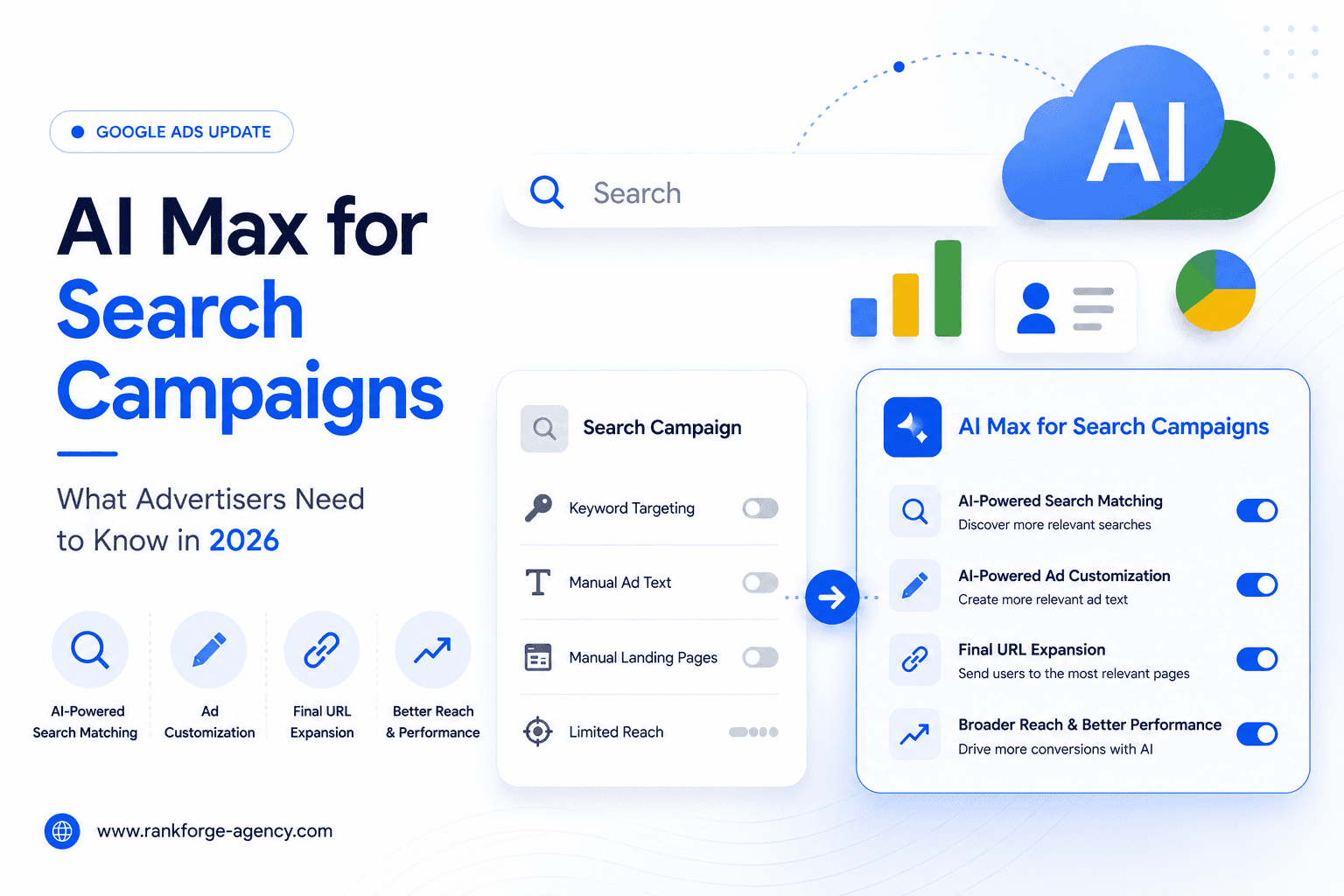
Google AI Max for Search Campaigns: What Advertisers Need to Know in 2026
Google Ads is moving further toward AI-powered campaign management.
In 2026, Google is transitioning several legacy Search campaign features toward AI Max for Search campaigns, creating an important change for advertisers who still rely on older campaign configurations.
Google announced that AI Max for Search campaigns is moving out of beta and that eligible campaigns using certain legacy features will begin transitioning automatically.
For advertisers, the important question is not simply whether AI is being added to Google Ads.
The bigger question is:
How should your Search campaigns be managed as Google moves more targeting, creative, and landing-page decisions into AI-powered systems?
This guide explains what AI Max is, what is changing, which advertisers may be affected, and how to prepare.
What Is Google AI Max?
AI Max is a collection of AI-powered capabilities for Google Search campaigns.
Google designed AI Max to help advertisers discover additional relevant searches and improve how ads connect with potential customers.
Its capabilities include areas such as:
- Search term matching
- Text customization
- Final URL expansion
These features allow Google's systems to use AI to identify additional opportunities, customize ad messaging, and connect users with potentially more relevant landing pages.
The goal is to expand useful reach while maintaining relevance.
score = (business_value * ranking_gap) / implementation_effortWhy Is Google Moving Toward AI Max?
Search behavior is becoming more complex.
People do not always search using the exact keywords advertisers anticipate.
Instead, users may:
- Use longer queries
- Ask questions
- Describe problems
- Use conversational language
- Search for specific situations
- Combine multiple intentions in one query
AI-powered campaign systems can interpret these patterns more broadly than traditional keyword-only approaches.
Google's move toward AI Max reflects this broader change in how Search advertising is managed.
What Is Changing in September 2026?
Google announced that some legacy Search campaign features will automatically transition toward AI Max beginning in September 2026.
This includes eligible campaigns using:
- Automatically Created Assets
- Campaign-level broad match settings
Google previously planned a broader Dynamic Search Ads transition during this period, but later extended the timeline.
The automatic upgrade for eligible Dynamic Search Ads campaigns is now expected to begin in February 2027.
That distinction is important for advertisers.
Not every legacy feature is following exactly the same timeline.
What Happens to Dynamic Search Ads?
Dynamic Search Ads are not being automatically transitioned on the same September timeline originally announced.
Google updated its guidance in June 2026 and extended the Dynamic Search Ads sunset timeline.
The automatic upgrade is now expected to begin in February 2027.
This gives advertisers additional time to review existing campaigns and prepare for the transition.
If your account still relies heavily on Dynamic Search Ads, this is a good time to start planning rather than waiting until the final transition period.
The Three Major AI Max Capabilities
1. Search Term Matching
Search term matching uses AI to help identify queries that may be relevant to an advertiser's campaign.
This can allow campaigns to reach searches that do not exactly match the advertiser's original keyword structure.
The opportunity is broader reach.
The challenge is control.
Advertisers should carefully monitor the searches that generate traffic and conversions.
2. Text Customization
AI Max can use AI to customize ad text based on the context of the user's search.
This is designed to make messaging more relevant to individual queries.
For advertisers, this creates an important shift.
Instead of writing every possible variation manually, Google's systems can generate and test variations within the campaign framework.
That makes creative review and brand controls more important.
3. Final URL Expansion
Final URL expansion can help Google direct users to a potentially more relevant page on the advertiser's website.
This can be useful when a website has strong information architecture and multiple relevant landing pages.
However, it also means advertisers should review their website carefully.
If your site contains:
- Outdated pages
- Weak service pages
- Duplicate pages
- Poorly optimized landing pages
- Irrelevant URLs
then automated landing-page selection may create less-than-ideal experiences.
A strong website is therefore becoming increasingly important to paid search performance.
AI Max Does Not Mean “Set It and Forget It”
One of the biggest misconceptions about AI-powered advertising is that advertisers no longer need to manage campaigns.
That is not the case.
AI can help with:
- Matching
- Creative
- Expansion
- Optimization
But advertisers still need to provide:
- Clear business goals
- Strong conversion tracking
- Good landing pages
- Quality creative inputs
- Audience insights
- Budget controls
- Brand guidelines
- Performance analysis
AI works within the information and signals available to it.
Poor inputs can still produce poor outcomes.
1. Check Your Conversion Tracking
Before changing campaign structures, review conversion tracking.
Make sure important actions are being measured correctly.
These may include:
- Purchases
- Lead submissions
- Phone calls
- Form submissions
- Bookings
- Qualified leads
- Revenue
Do not optimize an AI-powered campaign around a conversion event that does not represent real business value.
For lead-generation campaigns, for example, a form submission may be less important than a qualified sales opportunity.
2. Review Your Landing Pages
AI-powered targeting can increase the range of searches entering your campaigns.
That makes landing-page relevance increasingly important.
Review your key landing pages for:
- Search intent
- Page speed
- Mobile experience
- Clear messaging
- Strong calls to action
- Relevant content
- Trust signals
- Conversion opportunities
A campaign may find a valuable new search, but the landing page still needs to satisfy the user.
3. Improve Your Website Structure
Final URL expansion makes website structure especially important.
Your website should clearly communicate:
- What services you provide
- Which industries you serve
- Which problems you solve
- Which pages are commercial
- Which pages provide informational content
For example, an SEO agency should have clearly separated and useful pages for:
- Technical SEO
- Local SEO
- On-Page SEO
- Off-Page SEO
- AI Search Optimization
A well-organized website gives both users and advertising systems better destinations.
4. Review Automatically Created Assets
If your campaigns use automatically created assets, review how your ads are being assembled.
Pay attention to:
- Headlines
- Descriptions
- Landing pages
- Brand language
- Claims
- Offers
- Calls to action
Make sure the website itself contains accurate information that Google can use to create relevant advertising experiences.
5. Don't Ignore Search Terms
AI-powered matching can expand the queries entering your campaigns.
Search-term analysis therefore remains important.
Look for:
High-value searches
These may reveal new opportunities.
Irrelevant searches
These may require exclusions or negative keywords.
New customer language
These can reveal how potential customers actually describe their problems.
Unexpected intent
Some searches may look relevant but represent a different stage of the buying journey.
The goal is not to eliminate every variation.
The goal is to understand whether the traffic creates business value.
6. Reconsider Your Keyword Strategy
AI Max does not necessarily mean keywords are irrelevant.
Keywords still provide useful information about:
- Intent
- Themes
- Products
- Services
- Customer language
But advertisers should increasingly think beyond exact keyword lists.
Build campaigns around meaningful commercial themes rather than trying to predict every possible search variation manually.
7. Protect Your Brand
AI-powered advertising does not eliminate the need for brand control.
Define:
- Approved terminology
- Core offers
- Brand voice
- Restricted claims
- Important services
- Pricing language
- Geographic limitations
Review automated assets regularly.
Automation should help scale your strategy—not replace your brand strategy.
8. Watch Performance at the Business Level
AI-powered campaigns can generate more traffic.
But more traffic is not automatically better.
Track:
- Conversions
- Conversion value
- Cost per conversion
- Return on ad spend
- Qualified leads
- Revenue
- Lead-to-customer rate
For lead-generation businesses, connect Google Ads data with the actual sales process where possible.
A campaign producing 100 low-quality leads may be less valuable than one producing 30 highly qualified leads.
9. Give Google Better Inputs
AI systems perform better when they have useful signals.
Review:
- Conversion actions
- Audience signals
- First-party data
- Product or service information
- Landing pages
- Ad assets
- Business goals
The future of paid search is not simply:
AI does everything.
It is closer to:
Advertisers provide better inputs, and AI handles more of the optimization process.
10. Prepare Before Automatic Upgrades
If your account is affected by the September transition, do not wait for the automatic change before reviewing your strategy.
Create a transition checklist.
Before the upgrade
Review:
- Campaign objectives
- Conversion tracking
- Existing keywords
- Search terms
- Negative keywords
- Ad assets
- Landing pages
- Budgets
- Audience signals
- Performance history
After the upgrade
Monitor:
- Search volume
- Search intent
- Conversion rate
- Cost per conversion
- Conversion value
- Landing-page traffic
- New queries
- Asset performance
Compare performance against the previous campaign setup.
Avoid making multiple major changes simultaneously if you want to understand what caused performance changes.
AI Max vs. Traditional Search Management
| Area | Traditional Approach | AI Max Approach |
|---|---|---|
| Search matching | More manual keyword control | AI-assisted expansion |
| Ad creation | Manually written variations | AI-assisted customization |
| Landing pages | More manually controlled | Can use final URL expansion |
| Optimization | More manual | More automated |
| Search coverage | Keyword-focused | Broader query interpretation |
| Advertiser role | Direct campaign management | Strategy, inputs, controls, analysis |
The shift does not eliminate campaign management.
It changes where campaign management happens.
Advertisers increasingly need to focus on strategy, inputs, measurement, and quality control.
What Small Businesses Should Do
Small businesses do not necessarily need to rebuild every campaign immediately.
Start with the fundamentals.
Step 1
Confirm conversion tracking.
Step 2
Identify your highest-value services or products.
Step 3
Improve the relevant landing pages.
Step 4
Review current search terms.
Step 5
Clean up irrelevant traffic.
Step 6
Review your ad assets.
Step 7
Monitor performance after any transition.
This creates a much stronger foundation for AI-powered campaigns.
What Agencies Should Do
Agencies managing multiple accounts should create a repeatable transition process.
For every client, document:
- Current campaign structure
- Legacy features being used
- Conversion setup
- Search-term performance
- Landing-page quality
- Existing exclusions
- Brand controls
- Performance benchmarks
Then establish a monitoring period after the transition.
This makes it easier to identify whether changes are caused by:
- AI Max
- Seasonality
- Budget changes
- Website changes
- Market conditions
- Creative changes
Common AI Max Mistakes
Mistake 1: Increasing budget immediately
More automation does not automatically justify a larger budget.
Mistake 2: Ignoring search terms
Broader matching can reveal both opportunities and irrelevant traffic.
Mistake 3: Using weak landing pages
AI cannot fix a landing page that does not satisfy user intent.
Mistake 4: Measuring only clicks
Clicks do not necessarily represent business value.
Mistake 5: Ignoring conversion quality
A cheap lead is not useful if it never becomes a customer.
Mistake 6: Making too many changes at once
If everything changes simultaneously, performance analysis becomes difficult.
AI Max and the Future of Search Advertising
Google's transition toward AI Max reflects a broader change in digital advertising.
Search engines increasingly understand:
- User intent
- Context
- Language
- Business information
- Website content
- Conversion signals
Advertisers therefore need to optimize more than individual keywords.
They need to build a connected system:
Strong offer
↓
Relevant website
↓
Useful landing page
↓
Accurate conversion tracking
↓
High-quality ad inputs
↓
AI-powered campaign optimization
When these elements work together, automation has a stronger foundation.
AI Max Preparation Checklist
Before the transition, check:
- [ ] Conversion tracking works correctly
- [ ] Important conversions represent real business value
- [ ] Search terms are being reviewed
- [ ] Negative keywords are maintained
- [ ] Landing pages match search intent
- [ ] Website structure is clear
- [ ] Ad assets are accurate
- [ ] Brand messaging is consistent
- [ ] Budgets are based on business goals
- [ ] Performance benchmarks are documented
- [ ] Campaign changes are being monitored
- [ ] Lead quality is being measured
Final Takeaway
Google AI Max represents a significant change in how Search campaigns can be managed.
The direction is clear: more campaign decisions are being supported by AI, including search matching, ad customization, and landing-page selection.
But automation does not remove the need for strategy.
Advertisers still need to provide strong conversion signals, relevant landing pages, quality creative, clear business goals, and ongoing performance analysis.
If your Google Ads account is affected by the 2026 transition, the best approach is not to panic.
Review your campaigns.
Strengthen your website.
Improve conversion tracking.
Monitor search intent.
Protect your brand.
Then use AI-powered automation as a tool for scaling a strong strategy—not as a replacement for one.
Ready to turn this into a roadmap?
RankForge can audit your site, prioritize the best opportunities, and build the growth system behind them.
Request free audit